


Established in 1996 as an independent, accredited certification body, ERM CVS was created to deliver rigorous, value‑adding certification rather than a mass‑market checklist approach.
ERM CVS provides accredited and non-accredited certification and conformity assessment services for internationally recognized management system standards, helping organizations improve performance, strengthen governance and risk management, and build trust with stakeholders.
In a complex and fast‑evolving environment, our independent assurance confirms that management systems are effective, well‑maintained, and aligned with global best practice.
The ISO 9001:2026 final version has been published.
Join us on September 24 for an informal session on understanding what's changing with ISO 9001:2026 and the opportunities this brings to organizations.
Click here to reserve your seat
Independent certification proves conformity to globally recognized standards, giving stakeholders confidence in your management system.
It reinforces governance, risk management, and internal controls for more resilient operations, supporting operational consistency and continuous improvement.
Certification enhances credibility with customers, regulators, and investors by demonstrating transparent, reliable practices.
It also expands access to new markets, tenders, and supply chains through recognized, independently verified performance.
ERM CVS is recognized for its independence and excellence by regulators, investors, industry associations, interest groups and other key stakeholders. We hold the ISO/IEC 17021-1:2015 Accreditation for the certification of management systems in environmental, energy, sustainability and quality fields. Our expert global auditors work with organizations to deliver standalone or integrated management system certifications using internationally recognized standards that help improve compliance and performance.
ERM CVS can assist with certifications for a single system at a single site or multiple standards at multiple locations as well as integrated management system audits. Our deep sector expertise combined with our knowledge of different standards gives our auditors a unique understanding of business and certification drivers.
Our tailor-made audits focus on material risks and are underpinned by core principles that are designed to unlock greater operational performance and business value.
Overview
The traditional approach to management systems implementation and certification is to focus on demonstrating compliance with the requirements of a given ISO management system standard.
Most management systems are focused on documented processes. These processes are not necessarily consistent with the way managers get results in practice, even in heavily procedure-based operations, less than 30% of all activities are covered by detailed written procedures.
An approach focused solely or mainly on documentation leads to a disconnection between the system documents and reality; or as we term it, confusing the map for the territory. Having perfect documentation does not necessarily mean getting optimal performance on the ground.
We understand that managers use a broad range of techniques, which go far beyond the implementation of documented policies, procedures and work instructions, to deliver the operational and business outcomes they are seeking (production output, cost control, development of partner relationships and the like).
The ERM CVS Approach recognises that managers employ an effective range of techniques which deliver the right behaviours and outcomes within their operations. Our approach is designed to help businesses improve the performance and effectiveness of their management systems, not simply to improve their documentation.
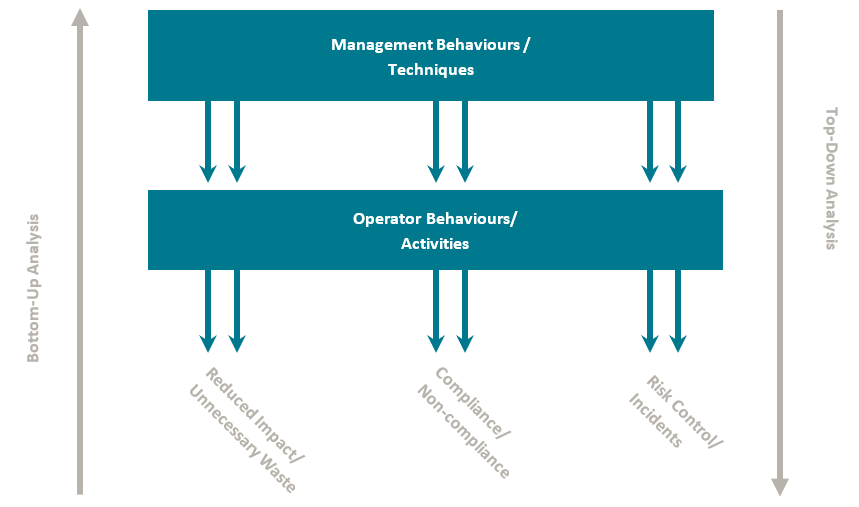
ERM CVS's assessment approach
ERM CVS tests these linkages through 'bottom-up' symptoms analysis and 'top-down' focused discussion with management.
The right outcomes will be produced if mainstream operational managers apply the techniques they naturally use in pursuit of their operational goals to address the relevant risks, opportunities, compliance obligations and performance objectives for which they are responsible. By recognising suboptimal performance and behaviour and identifying the underlying reasons for it, we assist the organization to focus improvement action on the right activities.
During the course of our assessments, we test whether managers are properly integrating relevant management system requirements into their activities in a way which will reliably support compliance, effective control of risks and opportunities, achievement of intended outcomes and continual improvement.
Our assessments are led by in-depth observation of conditions and activities at the site itself. Assessments start with a detailed site tour, where the ERM CVS team will establish – through direct observation – whether the organization is producing the right outcomes on the ground. Depending on the management system standard being assessed, our experienced assessors may identify nonconformities, examples of ineffective control, weaknesses in implementation, or opportunities for improvement. The content of the relevant ISO management system standard is integral to this ‘bottom-up’ analysis.
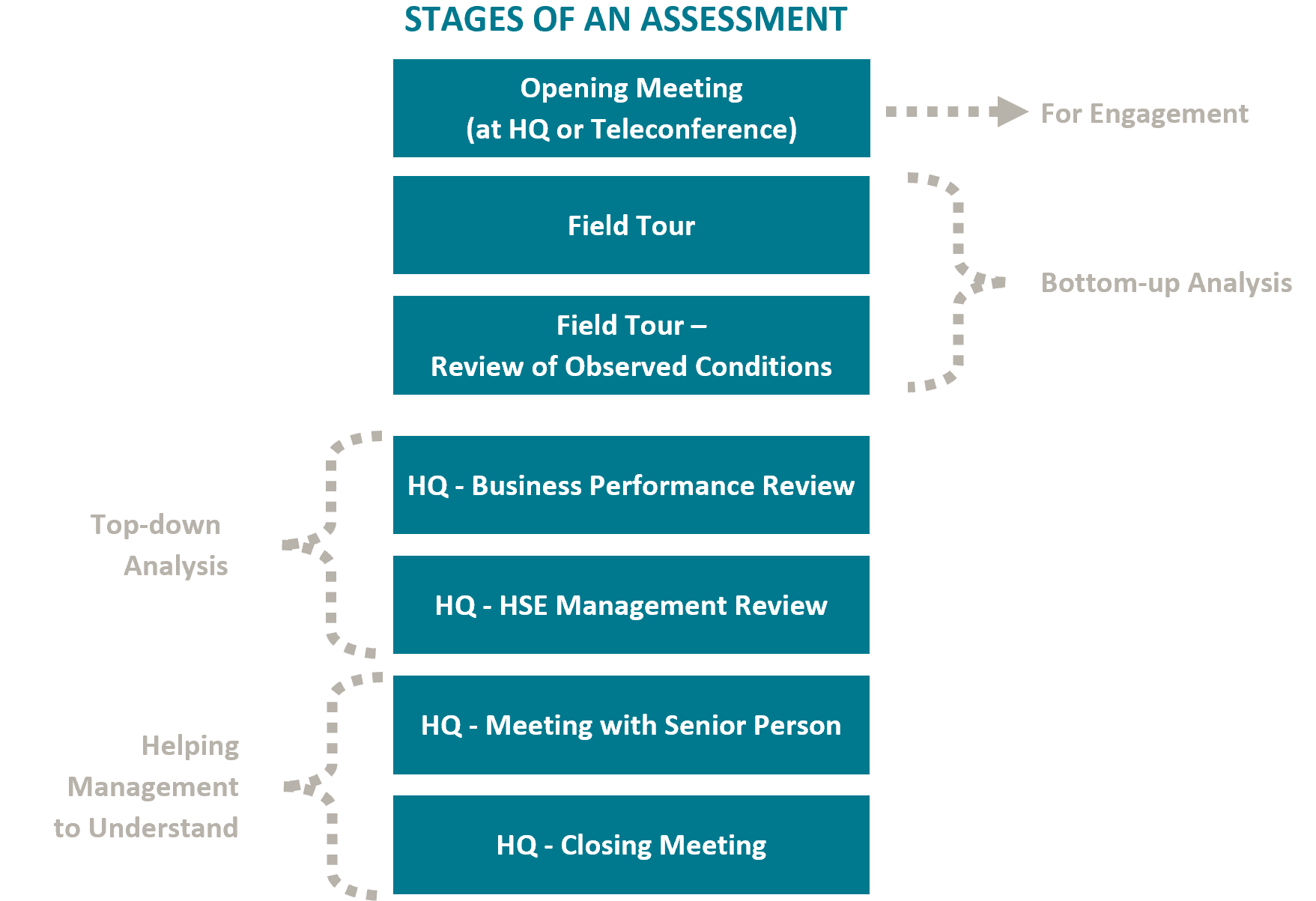
Opening Meeting
During the opening meeting the ERM CVS lead assessor will confirm the assessment scope and the programme for the assessment.
The Lead Assessor will also take time to ensure that management understands that they will be receiving feedback on the practical effectiveness of their established management system arrangements and the level of support operational and other personnel are providing to the relevant aspects of the organization’s activities.
Site Assessments
This is where we take our ‘field first’ approach and get into the operations to observe what activities are taking place and how they are undertaken.
During the course of the assessment, our experienced auditors focus on infrastructure, work practices, processes and areas of special interest relevant to the scope of certification and the management system standard being assessed. They seek - through direct observation - evidence of sound and unsound management practices.
We encourage our clients to take photographs of concerns we identify during the site assessment for use in the closing meeting and subsequently for their own training purposes.
The walk-rounds will allow management on site and the assessment team to develop a shared understanding of:
Business Performance Review
ERM CVS will conduct a review of overall business circumstances and emerging conditions through discussions with senior management. Areas of focus include mainstream operational excellence, financial performance, planned developments, and relationships with partners and other stakeholders. An insight into these issues will provide the assessment team with an understanding of the business context and pressures within which the management system operates; this is likely to be vital to understanding the strengths and weaknesses in the management system and its implementation within the operations.
Document Review
ERM CVS does not undertake an off-site document review as a stand-alone exercise. We may request certain documentation for our assessors to have sight of prior to the assessment but in the main we incorporate document review into our on-site activity. The types of documents we are likely to review in detail when on site are records associated with communications internally and externally, monitoring data, risk assessments, MOC analysis, KPI data analysis, compliance results and analysis, permit to work documentation, internal audit, management review etc.
Management Interviews
The management interviews – mostly with mainstream operational managers – will provide the assessment team (and on-site management) with an insight into the most effective management techniques employed within the operations and the extent to which these techniques are employed to address relevant requirements, risks, opportunities and intended outcomes.
The assessment team will typically interview senior management across a range of disciplines, operational managers, subject matter experts relevant to the scope of certification, finance personnel, human resource and training managers, performance improvement managers, facilities engineering and maintenance personnel, procurement specialists and contract management.
The requirements of the relevant standard are used as an agenda for the management interviews, which will be populated with observations and information collected during the on-site assessment and business performance review.
Meeting with Senior Manager
Prior to the closing meeting, the ERM CVS Lead Assessor will meet with the top-most manager for the operations and present their findings of the assessment. The primary purpose of this meeting is to provide senior management with an opportunity to digest the assessment findings, in advance of the closing meeting. This will then enable senior management to take the lead at the end of the closing meeting to set an appropriate forward direction.
Closing Meeting
Our closing meetings are designed to provide the management team with a realistic insight into the overall effectiveness of the management system arrangements they have established, and to provide a sense of how weaknesses may impact the organization’s ability to achieve the intended outcomes of certification.
We describe how we have spent our time on site and the observations that we have made during the assessment. Wherever possible we use relevant examples, and where appropriate photographs of issues observed during the site assessment, for this part of the presentation. We will provide feedback on the extent to which mainstream management are driving the relevant aspects of the management system and any specific weaknesses in the mechanisms employed by them in this regard.
Our goal: to ensure management understand how their behaviours and the mechanisms they have established are influencing operational behaviours and the practical effectiveness (or otherwise) of these in delivering effective control, compliance with applicable requirements, achievement of intended outcomes and continual improvement.
Reporting
The assessment team will prepare a report setting down a summary of issues reviewed during the assessment and any weaknesses in the management system which have been identified. The report will mirror the findings presented in the Closing Meeting. Our findings are set down in three parts:
Pathway to Certification and Enhanced Performance
Certificates of conformity to applicable ISO management system standards, which are valid for a three-year period, will normally be issued after completion of the relevant assessment process, which may include pre-assessment, Stage 1 and Stage 2 assessment activities as applicable. Following issuance of the certificate, the certified operations will be subject to surveillance assessments at planned intervals. The stages of the process and the tasks performed in each are described below.
Pre-assessment
Pre-assessments are an optional ‘extra’, which many of our clients incorporate into their programs because of the considerable benefits they derive from them. Pre-assessments will provide management with:
First Stage Assessments
First Stage Assessments are almost always performed on site and will incorporate each of the elements of the assessment process described in the preceding sections of this document. The purpose of the first stage, is to determine preparedness for the second stage.
Second Stage Assessments
Stage 2 assessments are performed on site where required by the applicable certification process. The assessment team will spend most of their time with managers, supervisors and operators assessing whether the organization’s management system arrangements are producing the right outcomes on the ground. Where shortcomings are observed, the team will seek to understand the management weaknesses which have given rise to them. The elements of the Stage 2 assessment are as follows:
Certification
ERM CVS’ decisions on certification are based upon the lead assessors’ evaluation of the extent to which management is engaged in driving management system performance and has established the practical means to deliver behaviours and outcomes which meet the requirements of the applicable standard. More specifically:
ERM CVS only certifies organizations which have the means to deliver these outcomes and are achieving them, thus ensuring that certification is regarded as a meaningful measure of the organization’s management system performance and conformity, both internally and externally.
If a positive certification recommendation is made, a certificate will be issued after:
Surveillance Assessments
In order to confirm that the certified operations continue to properly address the relevant requirements and intended outcomes associated with the certified management system, ERM CVS will perform surveillance assessments at planned intervals.
The surveillance assessments - like the initial assessment - will focus on ongoing control of relevant risks and opportunities, ongoing compliance with applicable requirements and continual improvement in management system performance.
During the surveillance assessment the team would focus on:
Recertification
ERM CVS certificates are issued for a three-year period after which a reassessment of the operations will be performed, the extent of which will depend on the frequency of surveillance assessments.
Conclusion
Ensuring that organizations obtain the benefits that can be realized through the implementation and maintenance of effective ISO management systems will be a significant challenge for management at all levels in organizations over the coming years and beyond. Achieving this end will require the involvement and co-operation of management and staff throughout the organization. Critically, it will also depend on the profile, capabilities, approach and professionalism of the certifier chosen to work with the operations.
ERM CVS works with its clients in a manner which will ensure that ISO management system certification enables organizations to enhance management system performance, demonstrate conformity with applicable requirements and gain maximum value from the certification process.
Changing the Scope of Certification
In response to a request for a change to the scope of a certification already granted, the Project Manager will undertake a review of the requested change and determine any audit activities necessary to decide whether or not the change may be granted. An extension to the scope of certification may necessitate further onsite auditing activity, which may be conducted in conjunction with a surveillance audit.
A description of ERM CVS’s behaviour and performance-based audit and certification process is available here.
Achieve regulatory compliance
Reduce risks and costs
Reduce reputational and operational risk
Secure stakeholder trust