
How can companies manage interconnected sustainability and business risks more effectively?
Climate change, nature loss, geopolitical disruption, supply chain pressures, community expectations, and financial risks do not affect businesses in isolation. They interact, amplify one another, and can create cascading operational and financial consequences.
Holistic resilience helps companies understand these connections and determine where action can address multiple risks.
Download BriefWhat is holistic resilience?
Holistic resilience is an integrated approach to understanding how sustainability-related risks connect with the wider forces affecting a business. It examines how climate, nature, social, supply chain, governance, financial, and geopolitical pressures intersect, compound, and cascade.
Understanding how sustainability-related risks and broader enterprise risks intersect can strengthen operations, improve investment decisions, and reveal opportunities for value creation.
What does the Holistic Resilience Pulse tell us about companies’ resilience readiness?
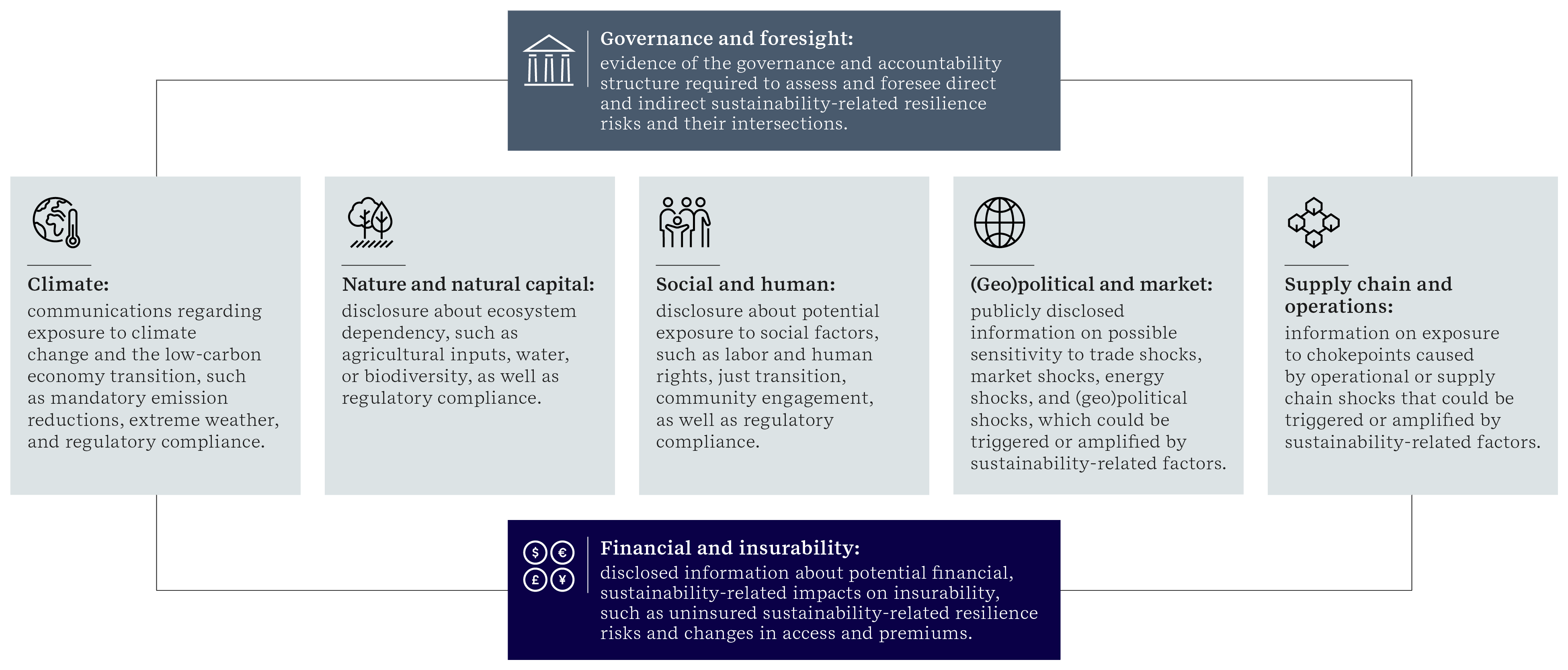
ERM applied its Holistic Resilience Pulse to the public disclosures of 18 global manufacturing companies across the aerospace, automotive, food, consumer goods, industrial goods, and luxury goods sectors. The analysis assessed evidence across seven domains that ERM considers central to resilience.
The five findings are:
- Public disclosures provide limited evidence that sustainability-related risks are being managed in an integrated way. Average disclosure scores did not reach the “established” level in any of the seven resilience domains, with limited evidence that companies assess how risks intersect and compound.
- Resilience risks are more often assessed qualitatively than quantified, limiting their usefulness for business decision-making. For climate risk, 83% disclosed qualitative assessments of hazards at their sites, compared with 28% disclosing quantified assessments and 11% disclosing preventive action.
- Resilience has reached the board agenda, but disclosures provide limited evidence of clear accountability for delivering resilience outcomes. Around three-quarters disclosed that business resilience was a recurring board-level topic, but evidence of clear individual accountability was limited.
- Insurability and loss exposure may be overlooked risks that could become barriers to accessing capital. None of the companies assessed the scope of uninsured losses from a severe catastrophe, while more than half provided no information about future availability to existing insurance.
- Disclosed impact assessments of external shocks such as trade-related disruption and energy supply appear limited for an increasingly shock-prone future. Companies generally disclosed qualitative rather than quantified assessments of potential trade-related impacts, while the majority provided no information about their exposure to energy supply shocks or available alternatives.
The assessment uses publicly available information and does not capture undisclosed policies or actions. Companies may therefore be doing more than their disclosures indicate, particularly in areas where disclosure is not mandatory.
How can companies build holistic resilience?
The briefing identifies three initial priorities:
- Quantify sustainability risks to prioritize action and demonstrate business value
- Strengthen integration and accountability at the governance level
- Build the operational foundations for holistic resilience
Read the briefing to explore:
- How resilience can be assessed across seven critical domains
- Five findings from the Holistic Resilience Pulse on where companies are today and where gaps remain
- How risks intersect, compound, and cascade across a business
- Practical steps companies can take to build a more holistic approach to resilience