


Prepare for CBAM with Confidence
If you manufacture products that are exported to the European Union, your customers increasingly need accurate and credible emissions data to meet Carbon Border Adjustment Mechanism (CBAM) requirements.
ERM CVS provides independent CBAM verification services for producers and manufacturers, helping demonstrate the accuracy and credibility of emissions data required to support customers' CBAM compliance obligations. By providing reliable emissions information, you can support your customers' compliance efforts, strengthen your position in the EU market, and prepare for evolving regulatory expectations.
Speak with a CBAM ExpertCBAM affects more organizations than many businesses initially realise. If you manufacture covered products destined for the EU market, or covered precursors that could be used to manufacture covered products destined for the EU market, CBAM should already be part of your compliance planning.
EU importers
Companies importing more than 50 tonnes a year of covered goods must hold authorised declarant status, hold CBAM certificates and surrender certificates based upon their declared embedded emissions. Companies below that threshold should still be tracking their imports in case that threshold is crossed.
Non-EU manufacturers
Producers of steel, aluminium, cement, fertiliser, hydrogen and electricity supplying the EU are increasingly asked for installation-specific, verifiable emissions data. Without it, punitive default values raise their customers' costs and erode their competitiveness.
Procurement, sustainability and ESG teams
Buyers, ESG leads and finance teams now carry CBAM exposure directly in supplier contracts and cost forecasts. Getting verification-grade data in place early is what keeps that exposure predictable.
The EU Carbon Border Adjustment Mechanism (CBAM) is transforming how emissions are reported and managed across global supply chains.
While the legal compliance obligations sit with EU importers, those importers depend on emissions data provided by manufacturers and producers outside the EU. As a result, organizations that export CBAM-covered products are facing growing requests for installation-specific emissions data that is accurate, transparent, and verification-ready.
Manufacturers that can provide reliable emissions information may help their customers avoid the use of conservative default values, better understand their CBAM exposure, and demonstrate greater supply chain transparency.
CBAM Challenges for Manufacturers
Many organizations are still developing the systems, processes, and technical capabilities needed to meet CBAM-related expectations. Common challenges include:
ERM CVS helps organizations address these challenges through independent verification services and technical expertise grounded in sustainability and carbon management.

Sustainability expertise at our core : ERM CVS is the certification and assurance arm of ERM, the world's largest pure-play sustainability consultancy. Emissions accounting, climate reporting, and sustainability assurance are central to what we do.

Deep carbon and GHG experience: Our teams bring extensive experience across greenhouse gas verification, emissions assurance, sustainability reporting, and climate-related regulations. This includes EU ETS which the CBAM MRV requirements are aligned to.

Global reach: With verification experts located across major exporting regions and the EU, we can support organizations operating complex international supply chains.

CBAM accreditation in progress: Like many certification bodies, ERM CVS is progressing through the CBAM accreditation process and expects to complete accreditation during 2026, positioning us to support organizations preparing for upcoming compliance deadlines.
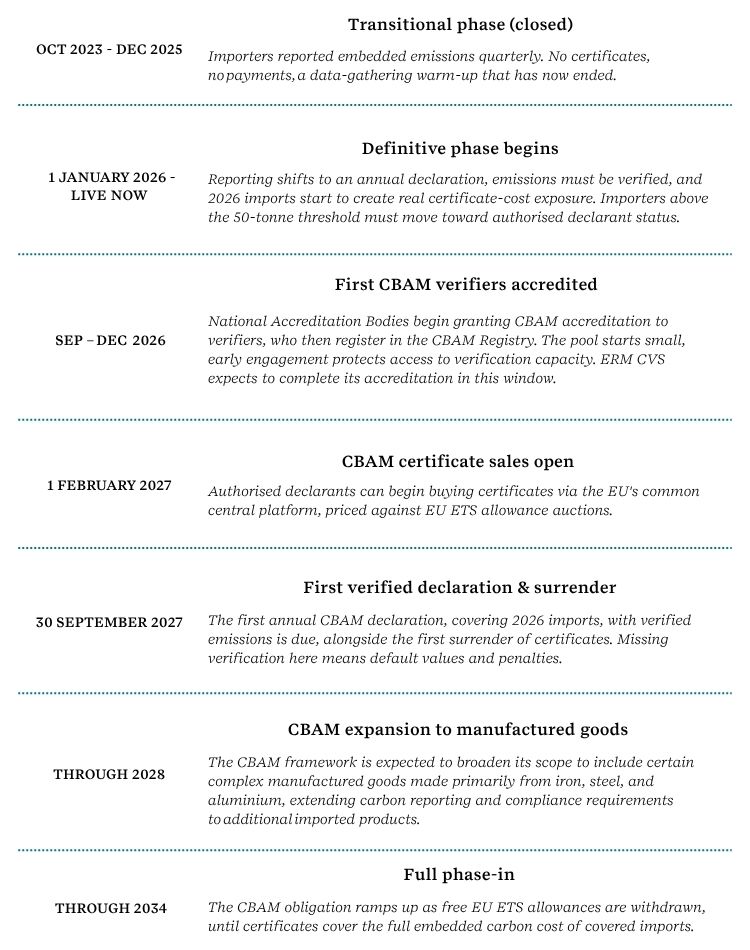
The reporting-only years are over. Here is what has already happened and the deadlines that now carry financial weight.
Talk to ERM CVS about your covered goods, your data readiness, and how we'll verify your emissions ahead of the 30 September 2027 deadline. Early conversations protect your access to verification capacity.
Contact usThe Carbon Border Adjustment Mechanism is an EU regulation (Regulation (EU) 2023/956) that puts a carbon price on emissions embedded in carbon-intensive imports. Its purpose is to prevent carbon leakage, the shift of production to countries with weaker climate rules, and to level the field between goods made inside the EU under the Emissions Trading System and goods made outside it.
In practice, importers of covered goods must report the embedded emissions of what they bring in and, from the 2026 compliance year, buy and surrender CBAM certificates to cover those emissions. To use actual (rather than costly default) emissions values, the underlying data must pass independent, accredited verification, which is where ERM CVS comes in.
EU importers bringing in more than 50 tonnes a year of covered goods and using actual embedded-emissions data must ensure that data is verified by an accredited third-party verifier. Therefore, non-EU manufacturers who export to the EU can expect requests for verified embedded emissions data from their customers.
EU importers bringing in more than 50 tonnes a year of covered goods and using actual embedded-emissions data must ensure that data is verified by an accredited third-party verifier. Therefore, non-EU manufacturers who export to the EU can expect requests for verified embedded emissions data from their customers.
Although CBAM obligations apply to EU importers, manufacturers are increasingly expected to provide accurate emissions data that supports importer reporting requirements.
Organizations may need to provide information relating to embedded emissions associated with the production of CBAM-covered goods, together with supporting evidence and calculation methodologies.
Embedded emissions are the greenhouse gas emissions generated during the production of a product and are a key component of CBAM reporting.
Verification provides confidence that emissions information is accurate, complete, and reliable, helping organizations support customer requirements and strengthen reporting credibility. It is mandatory if an importer wants to use actual embedded emissions as part of their annual CBAM returns.
Current CBAM coverage includes sectors such as iron and steel, aluminium, cement, fertilizers, hydrogen, and electricity.
The European Commission has indicated that CBAM may expand beyond the current sectors of iron and steel, aluminium, cement, fertilisers, hydrogen, and electricity. As part of the next phase of implementation, CBAM is expected to extend to certain downstream goods that incorporate CBAM-covered materials. While timelines and final scope remain subject to legislative approval, organizations operating in the following sectors should monitor developments closely:
CBAM entered its definitive phase on 1 January 2026. The first annual declaration, covering 2026 imports and requiring verified emissions, is due by 30 September 2027. Because the first verifiers are only accredited from around September 2026, the practical window to secure a verifier and complete site visits is tight.
Verifiers must be accredited to EN ISO/IEC 17029 by an EU National Accreditation Body for the verification of CBAM reports according to Delegated Regulation (EU) 2025/2551. ERM CVS, like other leading certification bodies, is in the process of securing CBAM accreditation, which we expect to finalise in 2026.
Without verified, installation-specific data, imports are valued using default emissions figures, which are deliberately conservative and typically raise certificate costs. Missing or unverifiable data can also lead to rejected declarations and financial penalties.
Understanding the process early can significantly reduce implementation challenges.
Step 1: Readiness Review
Assess current emissions data, applicable facilities, and reporting processes.
Step 2: Gap Analysis
Identify areas requiring improvement before verification.
Step 3: Verification Planning
Define scope, sites, timelines, and evidence requirements.
Step 4: Independent Verification
Review emissions data, methodologies, controls, and supporting records.
Step 5: Verified Reporting
Support readiness for annual CBAM declarations and regulatory review.