

 View all
For years, sustainability assurance has focused on one primary question: Are the numbers right?
Today, that question is no longer enough.
Organizations are increasingly being held accountable not only for the data they disclose but also for the story they tell around it. Regulators, investors, customers, employees, and civil society are looking beyond reported metrics to understand governance, strategy, risks, decision-making, targets, and progress. As a result, narrative disclosures are moving from supporting content to critical reporting evidence.
This shift represents one of the most significant developments in sustainability reporting.
The challenge is that many organizations have spent years building processes around quantitative reporting, while the controls, ownership, and documentation needed to support narrative disclosures remain far less mature. Yet it is often the narrative that stakeholders rely on most when assessing credibility and performance.
The new scrutiny facing sustainability disclosures
The growth of regulations such as CSRD, increasing adoption of ISSB-based reporting, and expanding stakeholder expectations are driving greater focus on qualitative disclosures. Organizations are being asked to explain not only what happened, but why it happened, what actions are being taken, and how decisions are governed.
These disclosures frequently cover:
- Strategy
- Governance
- Risks and opportunities
- Policies and commitments
- Targets and progress
- Management actions
Collectively, they form the narrative that surrounds and explains reported performance.
The reality is that a sustainability report can contain accurate data and still create assurance challenges if the narrative lacks evidence, balance, consistency, or clear ownership.
Moving beyond “Is the number right?”
Traditional assurance has focused on testing quantitative information and validating calculations.
Narrative assurance asks a different question:
Is the statement right?
That distinction may appear subtle, but it fundamentally changes the assurance process. Rather than simply verifying figures, narrative assurance examines whether disclosures are supported by evidence, consistent with reported data, and presented in a fair and balanced manner.
In many respects, narrative assurance represents the next evolution of sustainability assurance.
It moves the conversation from verifying data points to evaluating the credibility of the entire disclosure.
What narrative assurance actually looks like
Narrative assurance is sometimes perceived as subjective, but in practice it follows a structured process.
Assurance teams typically work through four key stages:
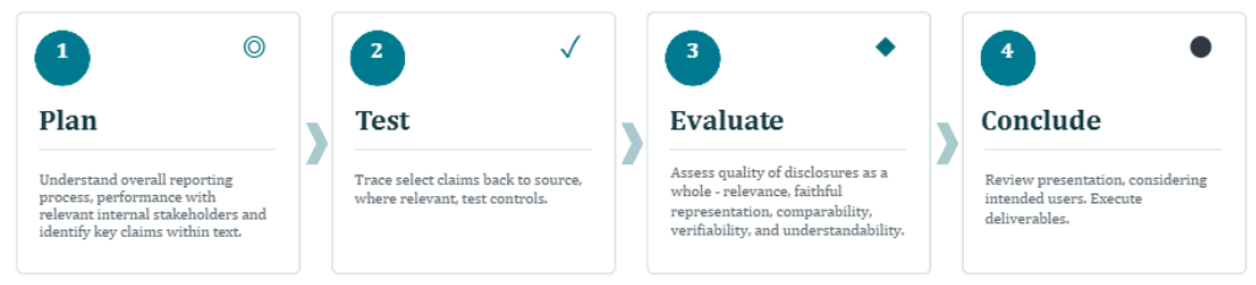
The emphasis throughout is on evidence.
Can the organization demonstrate that the narrative reflects reality?
Why readiness matters
A common misconception is that assurance begins when an assurance provider arrives.
In reality, successful assurance starts long before that point.
Organizations that perform well during assurance engagements typically have several characteristics in common:
- Clear ownership of disclosures
- Defined reporting processes
- Accessible supporting evidence
- Responsive subject matter experts
- Aligned review timelines
- Established governance controls
When these foundations are absent, assurance becomes slower, more complex, and more resource-intensive.
The most successful organizations treat assurance readiness as an ongoing capability rather than a year-end exercise.
The pitfalls organizations continue to encounter
Across narrative assurance engagements, the same themes appear repeatedly.
Evidence gaps
Claims cannot be demonstrated because evidence is incomplete, fragmented, or missing altogether.
Promotional language
Statements read more like marketing content than balanced disclosures supported by facts.
Unclear ownership
No one can clearly explain who wrote the disclosure, approved it, or owns the underlying evidence.
Late readiness
Organizations begin preparing disclosures too close to reporting deadlines, leaving limited time for challenge, revision, and assurance.
What good narrative disclosures have in common
High-quality disclosures are rarely the result of strong writing alone.
They are built on a foundation of robust processes, evidence, and governance.
The strongest disclosures consistently demonstrate five characteristics:
- Relevance
- Faithful representation
- Consistency
- Verifiability
- Understandability
Together, these principles support what many organizations are striving to achieve: trusted storytelling.
Because ultimately, sustainability reporting is about more than disclosure.
It is about enabling stakeholders to understand performance accurately and make informed decisions.
Turning assurance into a business advantage
Organizations that approach assurance strategically, VS solely compliance, often gain benefits far beyond regulatory readiness.
They strengthen governance and internal controls. They improve reporting quality. They create more reliable information for decision-making. They build stakeholder confidence. They improve consistency across business units and reporting cycles. And they develop a more credible and defensible narrative around performance.
In short, assurance can become a catalyst for organizational improvement.
The organizations extracting the most value from assurance are not waiting for regulations to force action. They are using assurance today as a tool to strengthen processes, challenge assumptions, and build trust.
A practical way forward
The journey does not need to begin with full regulatory assurance.
A phased approach often delivers the greatest benefit. - Start small and start early!
Many organizations start by conducting pre-assurance reviews of selected narrative disclosures. From there, they expand into limited assurance over voluntary reporting before ultimately integrating narrative assurance into broader regulatory reporting requirements.
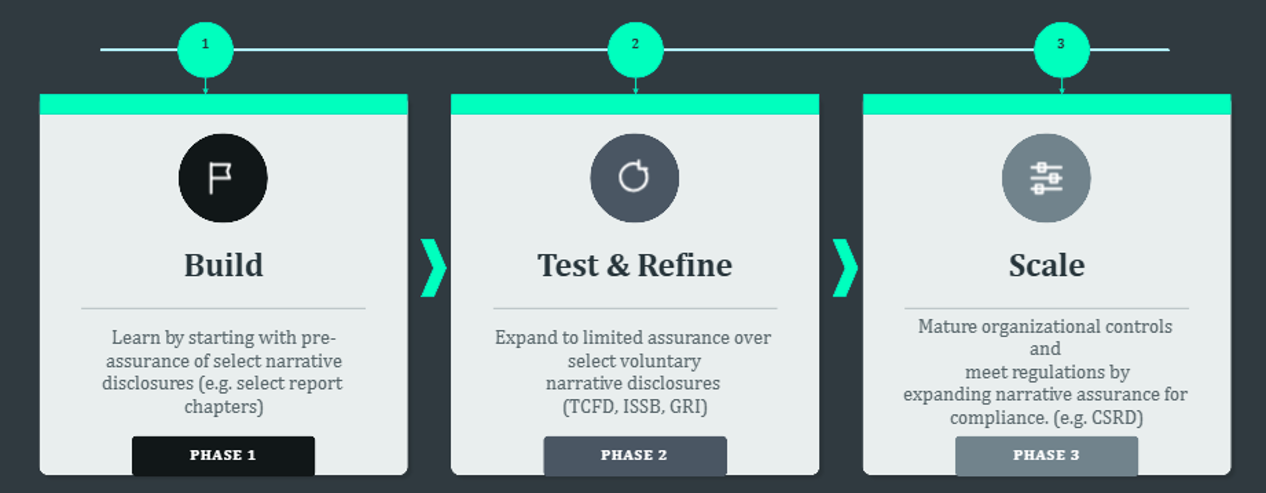
This approach enables teams to build capability, strengthen controls, and improve reporting maturity over time.
Most importantly, it allows organizations to begin benefiting from assurance long before it becomes mandatory.
The future belongs to trusted narratives
As sustainability reporting continues to evolve, the distinction between data quality and narrative quality will become increasingly blurred.
Organizations will need both.
Reliable numbers remain essential, but the narratives that explain those numbers are what stakeholders use to understand performance, assess credibility, and make decisions.
The future of sustainability reporting is not simply about reporting more information.
It is about reporting information that is supported by evidence, governed effectively, presented fairly, and trusted by stakeholders.
That is why narrative assurance matters.
And why the organizations that start building readiness today will be better positioned for tomorrow.
Want to learn more about Narrative Assurance? Watch our on-demand webinar and hear firsthand from our guest speaker from Teradata about her organization's experience and what narrative assurance looks like in practice.