
The Implementation Mindset: Why Sustainability Is Shifting to Execution
Sustainability strategies are being re-tested in real time.
Geopolitical disruption, regulatory divergence, and rapid advances in AI are forcing companies to rethink what’s achievable, and how to deliver it. The result is a clear shift: from long-term ambition to near-term execution, with a sharper focus on measurable business value.
In our latest trends report, ERM explores how leading organizations are turning sustainability commitments into tangible action.
Download the June 2026 Quarterly Trends Report
What’s driving the shift? Hide
Across sectors, companies are navigating a more complex, less predictable operating environment, while still under pressure to deliver on sustainability goals.
This report highlights how organizations are:
- Balancing AI-driven opportunity with real-world infrastructure constraints
- Reframing sustainability as a business performance lever, not just a long-term ambition
- Responding to investor and regulatory pressure for measurable, decision-useful outcomes
- Managing energy security alongside decarbonization priorities
- Adapting to diverging global regulatory expectations in EHS compliance
Understand the four trends shaping corporate action Hide
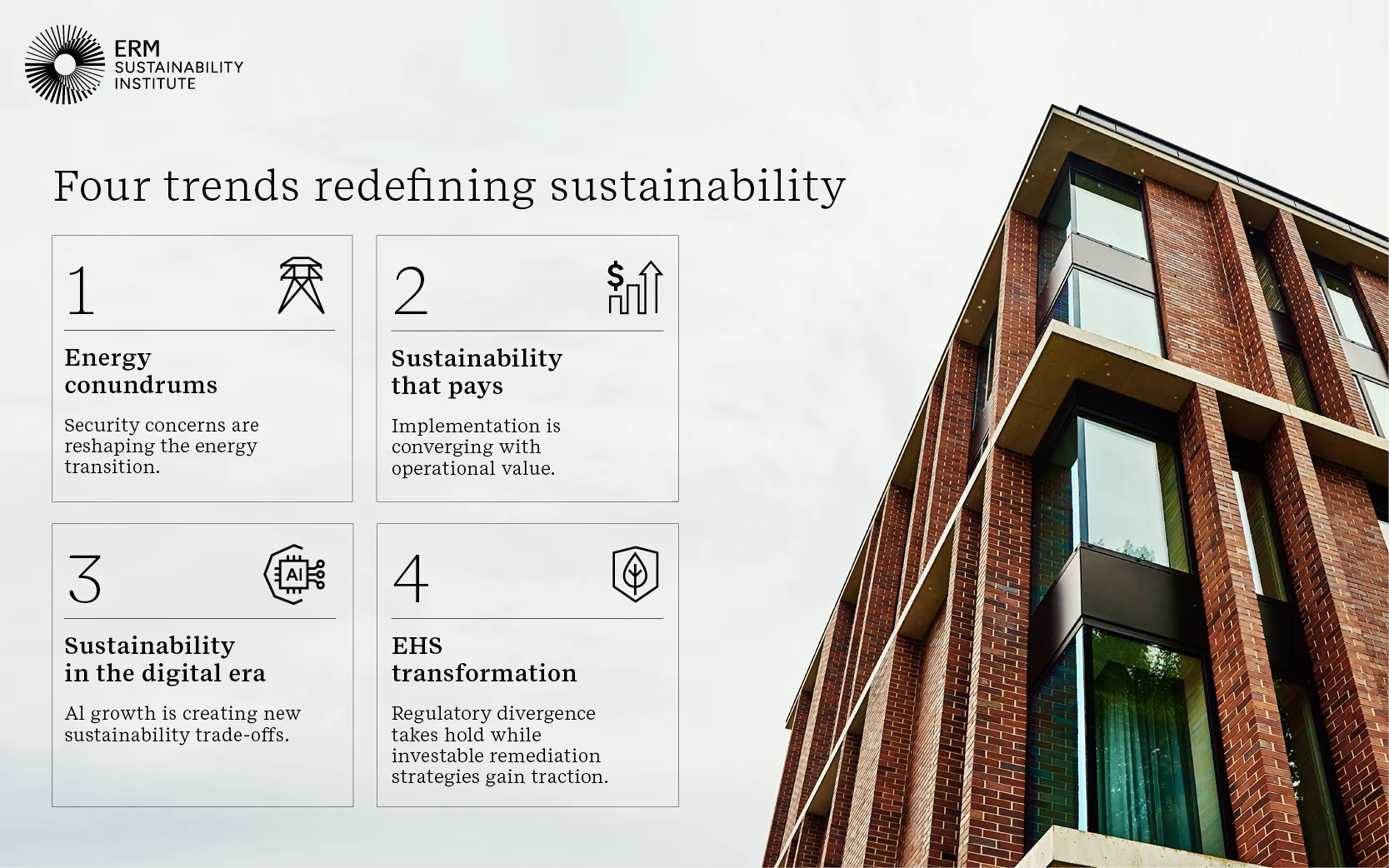
1. Sustainability in the digital era
AI is accelerating value, but also emissions, energy demand, and infrastructure pressure. Leading organizations are:
- Reassessing decarbonization pathways as emissions rise
- Securing clean energy while turning to carbon markets to bridge gaps
- Tackling physical constraints to AI growth across power, water, and supply chains
- Scaling AI to deliver measurable sustainability outcomes
2. Sustainability that pays
Stakeholders are increasingly focused on financial materiality and real-world delivery. Companies are responding by:
- Aligning sustainability strategies with enterprise risk and financial planning
- Embedding sustainability into core operations to unlock cost savings and returns
- Moving from target-setting to implementation-led execution
3. Energy conundrums
Energy strategies are being redefined under pressure from geopolitics and demand growth:
- Energy security is now as critical as decarbonization
- Renewables continue to scale, but grid constraints are slowing progress
- Companies are investing in resilience, flexibility, and diversified supply
4. EHS transformation
EHS priorities are evolving in response to changing regulatory landscapes:
- Diverging U.S. and EU approaches are increasing compliance complexity
- Focus on pollutants such as PFAS is intensifying
- Nature and water restoration are emerging as investable strategies
Why this matters now Hide
The sustainability landscape is no longer defined by ambition alone.
Investors, regulators, and markets are demanding clear evidence of execution and value creation and companies that can deliver will be best positioned to compete.
This report provides practical insight into:
- Where momentum is accelerating
- Where constraints are emerging
- And what organizations need to prioritize next