
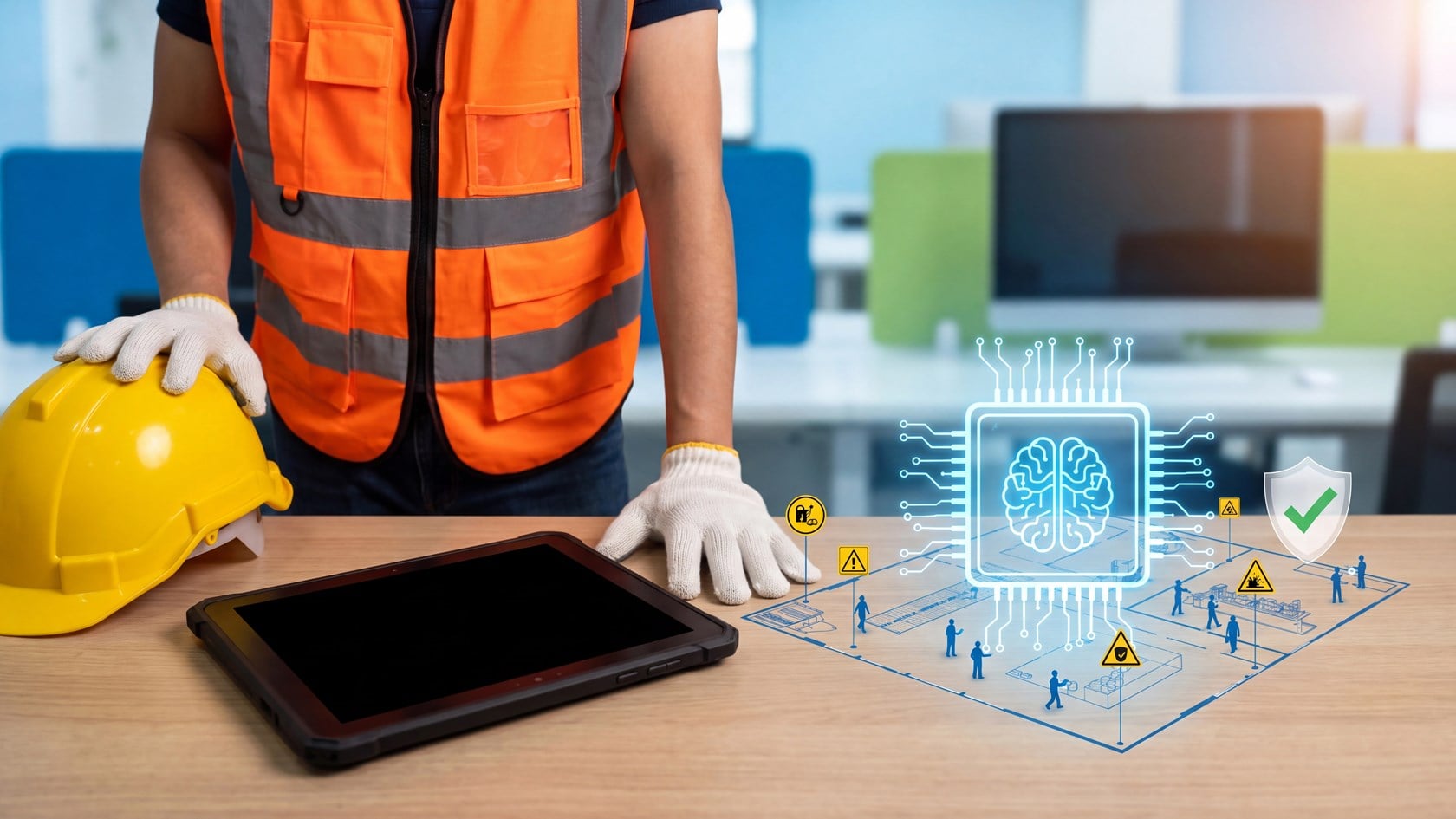
The people, skills, and processes that will shape the next generation of EHS
Rethinking the EHS operating model for an AI-enabled future
Artificial intelligence (AI) is rapidly changing how organizations access, interpret and act on information. For Environmental Health and Safety (EHS) functions, this creates opportunities to improve efficiency, strengthen decision-making and focus effort where human judgment adds value.
Many EHS functions were designed for a world of information scarcity: large central teams built on technical expertise, interpretation and access to information that was not readily available across the organization. While these capabilities remain important, AI is changing how information is generated and applied.
As this information advantage diminishes, EHS leaders are increasingly being asked to demonstrate what the function looks like, what it costs and how it creates value. Regulatory analysis, compliance assessments, reporting and data analysis can increasingly be supported by AI-enabled tools, allowing EHS professionals to focus on judgment, influence, and operational decision-making.
As AI capabilities mature, EHS operating models will need to evolve alongside them. This article explores what this shift could mean for the function and the capabilities needed to be effective.
Why EHS operating models are being reassessed
Many EHS operating models were established in the 1990s and early 2000s. Their structure, with a corporate center setting standards, regional advisors providing guidance, and site practitioners executing, reflected the information landscape of that era. The center held regulatory knowledge, technical expertise, benchmarking insights and incident learnings that were not readily accessible across the organization. This information asymmetry helped shape the governance structures, advisory models and operating approaches that many EHS functions still use today.
Advances in AI are changing how that information is accessed and applied. Today, a site EHS manager can review regulatory requirements, conduct an initial compliance assessment, access benchmarking information and develop draft procedures in a fraction of the time previously required. While this can improve efficiency and responsiveness, it can also create challenges around governance, consistency, and implementation if not properly managed.
At the same time, EHS functions are facing increasing cost pressures and growing expectations to demonstrate where the function creates and protects business value, while AI-enabled tools are changing how work can be delivered.
Many organizations continue to view AI as a future consideration for the next strategic cycle, technology roadmap, or digital transformation initiative. However, its impact is already being felt across a range of EHS activities.
Activities with significant potential for AI-enabled support include:
- regulatory compliance auditing and gap assessments,
- management system documentation,
- procedure development and review,
- incident reporting and causal analysis,
- training materials,
- regulatory change tracking, and
- performance reporting, trend analysis, and benchmarking.
For many EHS functions, these activities represent a substantial proportion of overall workload and cost. Current estimates suggest generative AI and related technologies have the technical potential to automate work activities that account for a significant share of employees' time today. As routine activities become increasingly automated, organizations are reassessing existing EHS processes and workflows that exist, how work should be distributed across the organization, and where human expertise and judgment remains the most important.
The temptation is to frame this as a technology adoption question: which tools to deploy and which workflows to automate first. However, organizations that layer AI onto workflows designed for a different era may realize limited upside, if the operating models remain unchanged.
Four key capabilities where human judgment will remain critical
As AI-enabled tools take on a greater share of routine and information-intensive activities, there is an opportunity to define more clearly where human judgment creates value and where AI can support execution. While the importance of judgment is widely recognized, many organizations have not explicitly defined what it means in practice, where it is needed most, or which roles should provide it.
We see an emerging shift from “human in the loop,” where AI performs parts of a process and passes work to a person, to “human above the loop,” where AI can perform most, or all of, a core process and review steps and people provide oversight and decision making. For EHS, that distinction is important.
Here are four areas where human expertise is most valuable.
1. Exercise judgment in complex, high-consequence situations
AI can identify indicators of potential non-compliance, but decisions in complex situations require consideration of an organization's risk appetite, regulatory relationships, commercial context, workforce dynamics, and site-specific history. Decisions with significant operational or business consequences continue to require human judgment.
2. Building trust in safety-critical environments
The ability to build trust with workforces remains a fundamental human capability. Trust is developed through presence, demonstrated competence, operational understanding, and the willingness to have difficult conversations when necessary. In safety-critical environments, the ability to earn respect, not simply compliance, influences how safety expectations are understood and acted upon. These qualities cannot be replicated by technology alone.
3. Providing organizational accountability
When boards and senior leaders seek assurance that EHS risks are being managed effectively, they ultimately need people who can stand behind the assessment and the decisions that follow from it. While AI can support analysis and decision-making, responsibility for assessing risk, providing assurance, and making defensible decisions remains a strategic, human obligation. Developing leaders who can exercise this responsibility credibly will remain an important role for the EHS function.
4. Navigate emerging risks where precedent does not exist
AI can be particularly effective where historical data and established patterns are available. Many emerging EHS challenges do not fit this model. Across sectors including power generation, oil and gas, manufacturing, pharmaceuticals, and chemicals, organizations are deploying advanced automation, autonomous equipment, AI-enabled control systems, and new materials at a pace that can outstrip existing assurance frameworks.
In these environments, incident histories may be limited, regulatory requirements may still be developing, and established benchmarks may not exist. Assessing these risks requires engineering judgment, operational experience, and the ability to evaluate scenarios that have little or no historical precedent.
In addition, regulatory expectations and industry practices continue to vary across sectors and jurisdictions. Leaders who can combine technical expertise with operational insight and sound risk judgment will be better positioned to assess uncertainty, challenge assumptions, and make informed decisions in rapidly evolving environments.
As organizations adopt new technologies, EHS professionals have an opportunity to play a greater role earlier in the decision-making process, including in capital projects, technology deployment, design reviews, and operational decisions. These areas place increasing value on expertise that can help organizations design, implement, and scale new systems safely and effectively, positioning EHS not only to assure decisions but to help shape them.
Priorities to build the future EHS function
EHS leaders need to start evaluating how their functions, capabilities, and operating models need to evolve.
Here are five priorities that can help EHS leaders support this transition:
1. Assess where the function creates value. Map how the EHS function currently spends its time and identify which activities depend on human judgment, stakeholder engagement, and decision-making, and which could be automated or augmented by AI. An honest understanding of the current state provides an important foundation for future operating model decisions.
EHS leaders can start with standardized activities such as regulatory intelligence and monitoring, audit and compliance support, document and knowledge management, and visual intelligence. Organizations should also consider whether all the capability needs to be maintained internally. Managed EHS Services can provide an alternative model, allowing organizations to access specialized expertise and technology without building the capability in-house.
2. Strengthen data foundations before scaling AI. Many EHS functions continue to face challenges with fragmented systems, inconsistent definitions, paper-based processes, and siloed datasets. Addressing these issues is a prerequisite for effective AI adoption. Without reliable and consistent data, organizations risk automating inefficient processes rather than improving them.
3. Establish a role in AI governance. Decisions about AI deployment are often led by IT, operations, or procurement teams, yet many of the implications have direct relevance for EHS. EHS leaders should ensure that human-machine interactions, AI-enabled decision-making, workforce impacts, and safety considerations are incorporated into governance and oversight processes from the outset.
4. Redefine future talent requirements. With automated traditional EHS activities becoming the standard, future EHS functions and the people within them will need to build new capabilities. Greater emphasis will be placed on strategic thinking, independent judgment, stakeholder engagement, AI governance, and leadership in complex operating environments. Talent and development strategies should evolve accordingly.
5. Connect EHS performance to business value. EHS functions have traditionally focused on indicators such as incident rates, compliance performance, and near-miss reporting. While these remain important, senior leaders and investors increasingly view EHS performance through the lens of risk management, resilience, and business value. Demonstrating how EHS contributes to these outcomes can strengthen the function's influence and support investment in future capabilities.
What this means for EHS leaders
The EHS profession has navigated significant periods of change before. These include the transition from reactive safety approaches to integrated EHS management, the globalization of standards, and the integration of sustainability into business decision-making. Each required the function to adapt its role, capabilities, and ways of working.
AI presents a different challenge. While it has the potential to automate or augment many routine and information-intensive activities, it also creates an opportunity for EHS professionals to focus more of their effort on areas where human judgment, leadership, accountability, and workforce engagement remain essential.
EHS functions will need to invest in the data foundations, governance, talent, and capabilities needed to operate effectively in an AI-enabled environment. The opportunity is not simply to improve efficiency, but to strengthen how EHS contributes to risk management, operational performance, and organizational resilience.
For EHS leaders, the focus should therefore extend beyond how to adopt AI to whether they would design their EHS function in the same way today, given what AI can do and how the nature of EHS risk is changing. The future of EHS will not be defined by technology alone, but by how effectively organizations combine AI-enabled capabilities with the human expertise required to manage complex risks and support business performance.
ERM can help EHS leaders assess how AI is impacting their function’s operating model, identify opportunities to create value, and develop the capabilities needed for the future.