
 View all
 Australia's corporate renewable energy market is approaching a significant inflection point. Following a relatively subdued period of procurement activity in 2025, many organisations have adopted a wait-and-see approach, encouraged by lower wholesale prices, easing futures markets and the perception of an abundant renewable development pipeline. However, the underlying dynamics of the National Electricity Market (NEM) suggest this window of opportunity may be narrowing rapidly.
ERM's analysis indicates that a substantial wave of renewable contracting demand is building towards 2030. The combined impact of expiring retailer and corporate PPAs, near-term corporate decarbonisation commitments and growing electricity consumption from energy-intensive industries subject to renewable contracting policy obligations, including the rapid expansion of data centres, could drive approximately 62 TWh per annum of renewable contracting demand by 2030. Even under more conservative assumptions, assuming expiring retailer and corporate PPAs recontract with operational projects, new annual demand by 2030 remains material at approximately 36 TWh per annum, i.e. equivalent to around two-thirds of the NEM's current large commercial and industrial electricity consumption.
A particularly significant development is the emergence of data centres as a new class of renewable energy buyer. Proposed policy obligations may require large data centres to demonstrate both 100% renewable electricity procurement and compliance with prescribed firming requirements. Data centres are expected to triple their electricity consumption by 2030, creating substantial new demand for both renewable generation and dispatchable capacity. Given the procurement preferences of hyperscale and colocation operators, direct contracting with renewable and storage projects is likely to be common.
At the same time, renewable procurement is becoming more complex. Buyers can no longer focus solely on securing renewable energy volumes. Organisations contracting directly with renewable and storage assets must also manage basis risk (interaction between spot-settled generation revenues and futures-linked retail electricity costs) associated with portfolio construction, including consideration of the role of firming. Consequently, renewable electricity procurement is evolving from a sustainability or future compliance exercise into a broader strategic risk management challenge.
While the renewable and storage development pipeline appears strong, supply adequacy remains far less certain than headline project numbers suggest. The 2026 Electricity Statement of Opportunities (ESOO) forecasts no system-wide reliability shortfalls before 2030-31, but this outlook depends on the successful delivery of around 50 GW of committed and anticipated projects. Only a relatively small proportion of this capacity is fully committed, with the remainder exposed to financing, transmission, connection and delivery risks. Evidence from the Capacity Investment Scheme pipeline and AEMO's project connection data suggests many projects continue to experience delays, rising costs and slower progression to financial close.
When looking at New South Wales (NSW) – applying ERM’s somewhat different definitions of committed and anticipated as defined by AEMO – the chart below presents our assessment of the adequacy of supply in NSW in the period to 2032. Taken together, demand side factors point to an increasingly competitive market for renewable offtakes through to 2032.
Forecast electricity supply adequacy in NSW relative to forecast corporate renewable demand by 2032
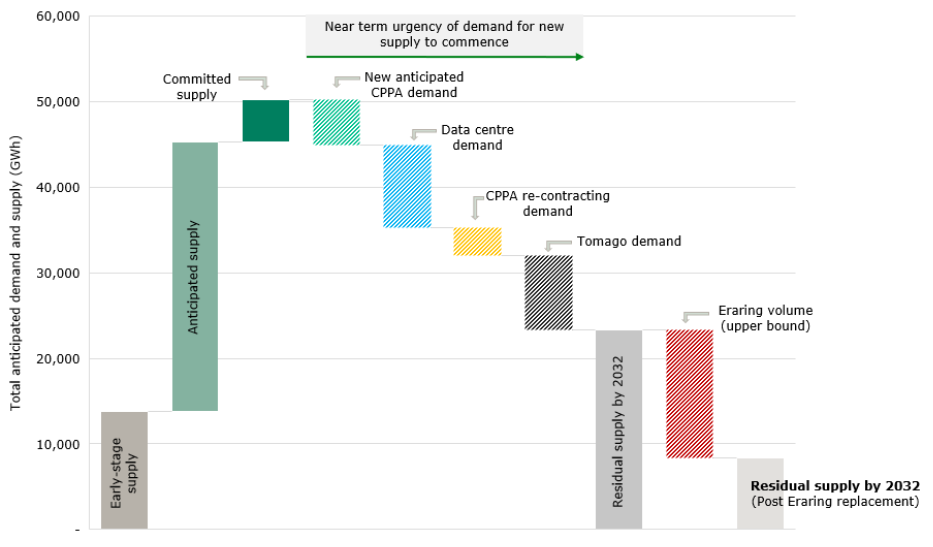
The practical implication is that the volume of projects under development should not be mistaken for the volume of projects that can realistically be financed, constructed and connected within the required timeframe. In NSW, forecast renewable demand from corporates, data centres, retailers and major industrial users could absorb a substantial proportion of the committed and anticipated renewable pipeline before accounting for the replacement of retiring coal-fired generation.
As competition for renewable generation, storage and firming capacity intensifies throughout the second half of this decade, organisations most likely to succeed will be those that act early, establish a clear target operating portfolio, develop a robust risk management framework and evaluate procurement decisions through a long-term portfolio lens rather than simply seeking to meet sustainability and regulatory obligations, or maximise renewable matching on an interval basis.
In short, the key risk is no longer that renewable energy prices may rise or fall. It is that access to the most attractive renewable and storage opportunities becomes increasingly constrained. Waiting remains a strategy, but in a market characterised by rising demand, execution risk and growing competition, it is unlikely to be the optimal one.
Read our full analysis on Australia’s corporate renewable energy market here.