
A practical roadmap to net zero for a sector the world’s food system depends on, balancing emissions reduction with food affordability, food security, and long-term resilience.
An EBRD initiative, developed by ERM and Systemiq, in collaboration with IFA.
Phosphate and potash fertilizers are foundational to the global food system. Together with nitrogen, they underpin agricultural productivity, crop resilience, and food security worldwide. Yet their production is energy- and resource-intensive, tightly linked to industrial and energy systems, and increasingly exposed to climate, policy, and market risk.
As global demand for food continues to grow, the phosphate and potash (P&K) industry faces a defining challenge: to decouple production from emissions while maintaining food affordability and security of supply. Without action, the gap widens. Under business as usual, total sector emissions are set to reach 550 MtCO₂e per year by 2050, an approximate 25% increase from today, with limited scope for efficiency improvements alone to offset rising demand.
Download the RoadmapThe long-term direction of travel
This roadmap sets out the direction of travel for decarbonizing P&K fertilizer production towards 2050, in alignment with the Paris Agreement and the IPCC’s net zero goals. The analysis shows that deep emissions reductions - close to 89% of production emissions under a net zero by 2050 scenario - are technically feasible, though achieving them requires large-scale changes to production systems and regulation, involving significant economic and environmental trade-offs. Technologies required to decarbonize fuel use and address process emissions are at varying stages of maturity and require demonstration and scale-up.
The transition is not a single pathway, nor a uniform timeline. Regional starting points, production routes, technology readiness, and access to enabling infrastructure mean outcomes will vary considerably.
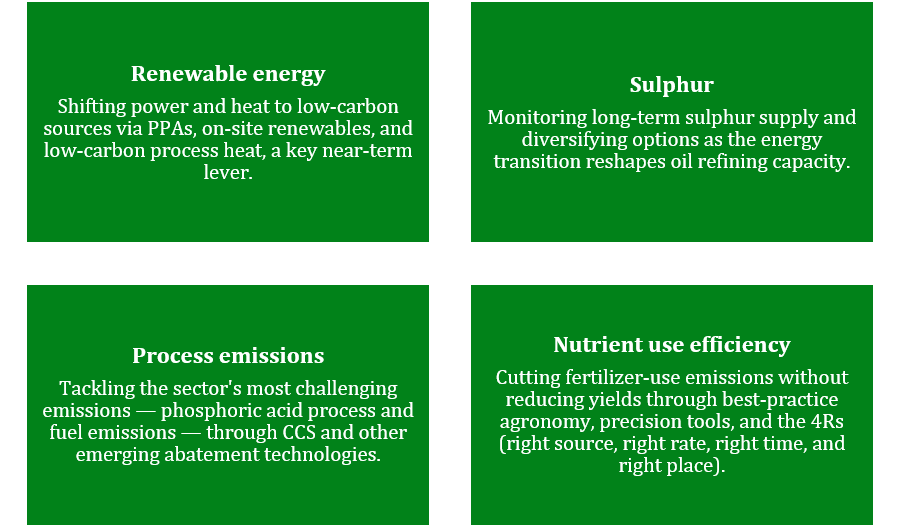
Four levers anchor the change ahead:
The case for near-term action
Decarbonization also brings tangible benefits: reduced exposure to volatile raw materials and energy inputs such as ammonia, sulphur, and fossil fuels, and improved access to concessional finance. Given the capital-intensive nature and long life of P&K assets, embedding decarbonization into existing operations now is essential to avoid lock-in, mitigate energy-market risk, and position the industry for more transformative change post-2035.
Interim emissions metrics should balance absolute reductions with food security and affordability. Sectoral emission intensity or asset-level approaches, driven by targeted, economically attractive near-term initiatives, better reflect the industry's complexity and food-security imperatives.
Investment and priority actions
Delivering this transition requires a step change in investment, from across the value chain and from governments. Globally, decarbonizing production emissions in line with a net zero by 2050 goal is estimated to require US$235–320 billion of investment in production assets, alongside substantial progress in technology deployment and policy support.
A shared call to action
The transition is challenging and it depends on coordinated action across the value chain:
- Agri-food conglomerates and downstream retailers to create market pull for low-carbon fertilizers.
- Producers to act early on novel technologies and embed decarbonization readiness into capital decisions;
- Financiers to mobilize capital at scale through blended and risk-sharing mechanisms;
- Policymakers to provide clear, credible long-term signals and invest in enabling infrastructure; and
- Standard setters to develop fertilizer-specific, food-secure target-setting guidance that enables flexible emission intensity- and asset-based pathways.
Achieving decarbonization at the pace and scale required will necessitate coordinated action across all of these groups.
“Decarbonizing the phosphate and potash industry is not only a climate imperative: it is a strategic opportunity to reinforce competitiveness, resilience, and food-system stability in a rapidly changing world.”
Download the RoadmapEndorsed by European Bank for Reconstruction and Development (EBRD), World Business Council for Sustainable Development (WBCSD), International Council on Mining and Metals (ICMM).
This roadmap was developed by ERM in partnership with Systemiq and in collaboration with EBRD and the International Fertilizer Association (IFA), with significant input from industry through workshops, surveys, and feedback.