
 View all
 At midday on 21 August, a total of 206 financial year end listed companies had published their financial results. Of these companies 87 reports included AASB S2 compliant disclosures. We have taken a closer look at these reports to see what we can learn from them. In this short article we present an overview of the reports, dig into what is done well, and where the gaps are as well as what the best next steps are to support next steps in disclosure. We have done a deep dive into metrics and targets and looked at how companies are including financial implications of climate impact on their businesses.
A snapshot of our findings
The table below summarises the reports we have reviewed in this analysis. This table includes the details of the sectors into which we have grouped these reports for the purposes of this analysis.
Summary of reports and results
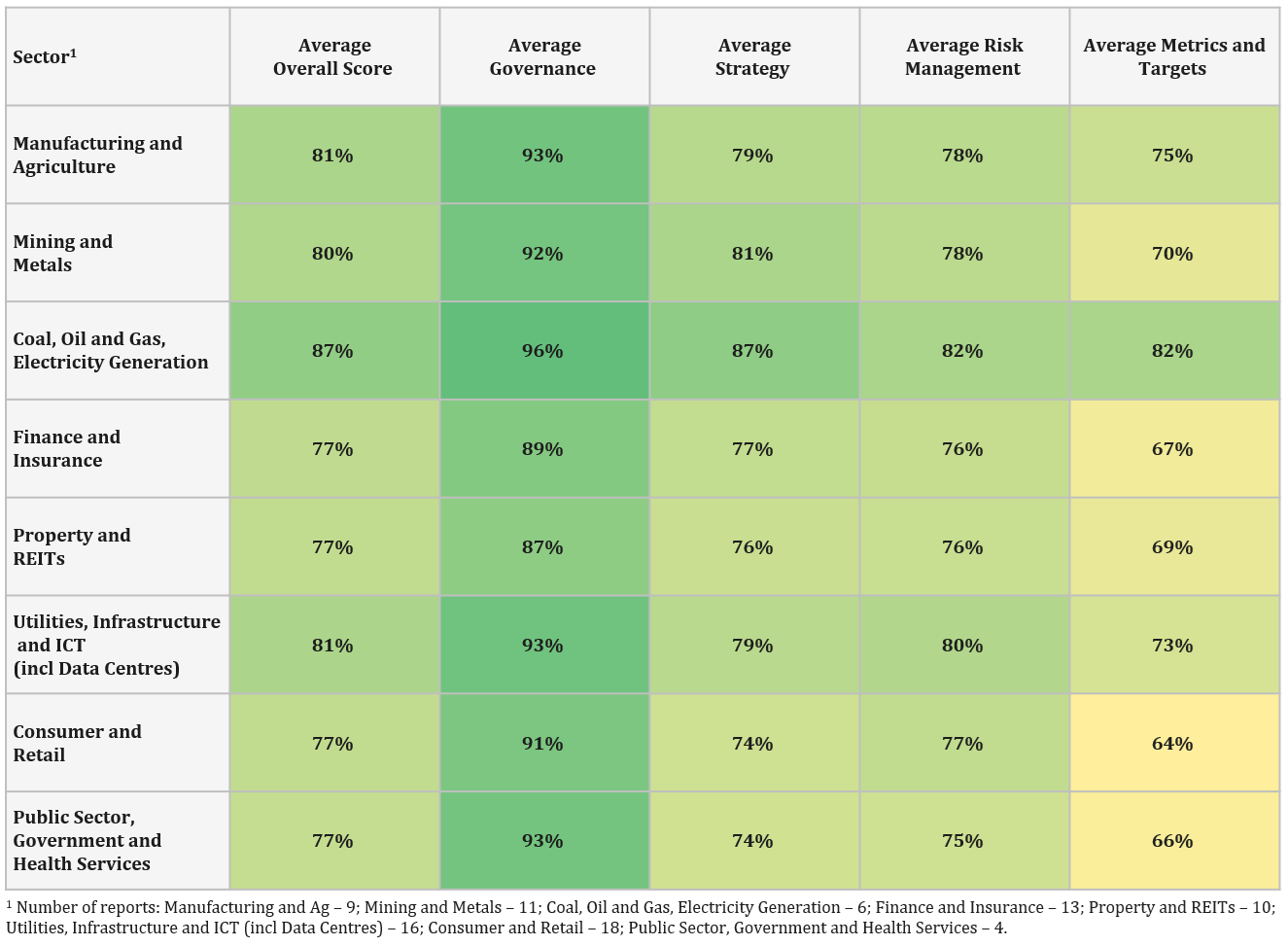
This result is consistent with our previous observation that the Governance pillar is most well addressed in company disclosures, and that the Metrics and Targets pillar is least mature. The Energy sector is the most mature in its disclosures, with Manufacturing also performing well across the pillars. We note that board oversight and climate accountability structures are typically well established. Climate risk management is more mature than strategy and metrics in most sectors. Most sectors disclose emissions targets and governance arrangements. A review of what is done well by the sectors is included as an appendix to this paper.
As the number of reports has increased it has been less useful to draw detailed conclusions across sectors as results have become more disparate with number of reports. The histogram below illustrates the spread of results. This shows that disclosure maturity is skewed towards a “Good” outcome with more than half of the results falling between 75% and 85%. However, the results tail off very rapidly demonstrating that there is limited ambition for best-in-class reporting, with many companies focusing on legally compliant reports. Given the significant effort required to deliver these reports this is a very strong result for the market as a whole.
Distribution of report results
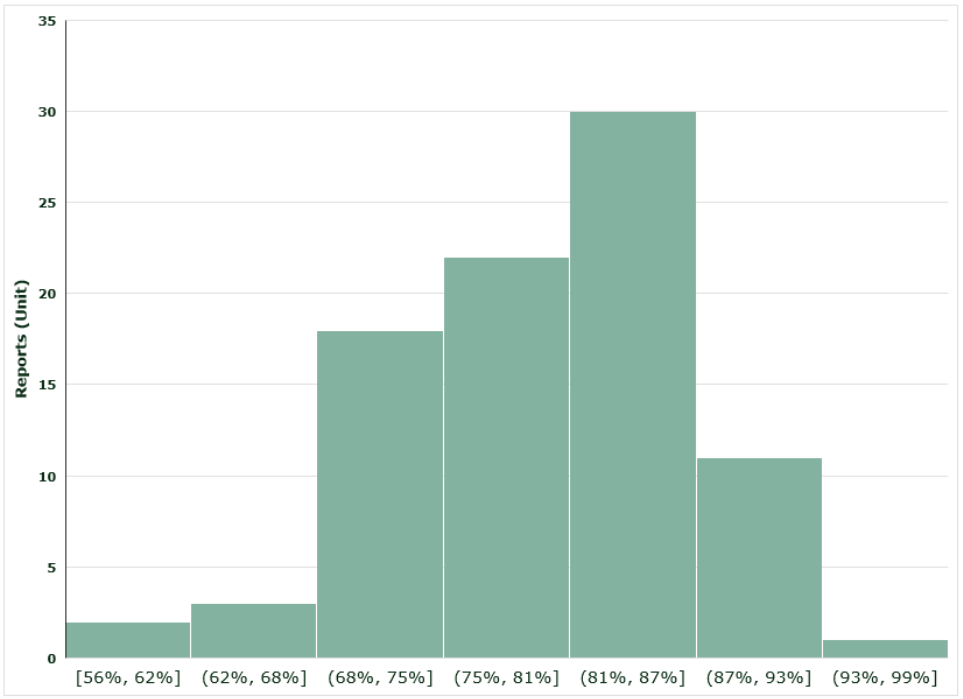
Note: Given the limited number of company reports available for the Public Sector, Government and Health Services grouping we have not included a sectoral analysis of these results.
Challenges and next steps
While sector disclosure maturity differs, the nature of the gaps is remarkably consistent across the disclosing organisations. These conclusions are drawn based on the sectoral results included in the appendix to this paper.
- Financial quantification remains the largest gap: Most organisations describe climate risks and opportunities qualitatively but do not quantify the potential financial impacts on revenue, costs, assets, cash flow, capital expenditure or enterprise value. This is the most common limitations across all sectors and reduces the decision-usefulness of disclosures for investors and regulators.
- Climate transition plans are generally immature: Many companies have emission reduction or net-zero ambitions, but relatively few provide a detailed climate transition plan showing implementation actions, milestones, capital requirements, governance arrangements and progress measures. Transition planning remains one of the least mature aspects of climate disclosure across all sectors.
- Metrics and targets are not yet comprehensive: Many organisations do not disclose Scope 3 emissions, interim milestones, progress tracking, opportunity metrics, adaptation metrics and value-chain reporting. Governance processes have generally matured faster than the metrics needed to demonstrate performance and progress. As a result, Metrics & Targets is typically the weakest scoring pillar.
- Adaptation and resilience investments are rarely quantified: Most companies discuss physical climate risks and resilience responses, but few quantify adaptation costs, resilience CAPEX/OPEX, avoided losses, investment requirements or return on resilience investments. This represents a major gap as investors increasingly seek evidence of how resilience strategies will be funded and implemented.
- Climate is not fully integrated into business strategy and capital allocation: Across sectors there is limited evidence that climate considerations are driving investment decisions, portfolio changes, asset management strategies or capital allocation decisions. Many disclosures treat climate as a sustainability issue rather than demonstrating how it influences the core business strategy and financial decision-making.
The actions that would address the principal gaps identified and which are likely to deliver the largest improvements in future AASB S2 disclosure scores across all sectors are mostly self-evident:
- Move from qualitative to quantified disclosures by estimating financial impacts.
- Develop credible climate transition plans with milestones, actions and accountability including due consideration of capital requirements.
- Strengthen metrics and targets, particularly Scope 3 and progress tracking.
- Quantify adaptation and resilience investments including CAPEX, OPEX and avoided losses.
Deep dive on targets and their linkage to CTPs
We have taken a detailed look at the targets disclosed in the reports, and looked at how they link to climate transition plans (CTPs) and the delivery of more resilient companies. General observations are included in the table below. Sector details are included in the appendix to this paper.
Observations on Targets and transition plans
|
Observation |
Overall finding |
|
Net-zero targets |
Most companies across sectors have now disclosed some form of net-zero, emissions reduction or decarbonisation target. |
|
Interim targets |
Many organisations disclose 2030 targets, but detailed milestones, action plans and pathways remain inconsistent. |
|
Scope 3 targets |
Scope 3 remains one of the weakest target areas due to transitional reliefs and incomplete inventories. |
|
Transition plans |
Transition planning is consistently less mature than target setting, with many companies disclosing ambitions without implementation roadmaps. |
|
Capital allocation |
Explicit links between targets and capital expenditure, investment decisions or funding commitments are uncommon across all sectors. |
|
Progress reporting |
Companies are generally better at reporting emissions performance than explaining how targets will be achieved. |
We have looked at how well companies are disclosing their CTPs. While disclosure can lag the existence of a plan, some companies may have started on a plan but it was not well enough developed to include in a Year 1 disclosure, many companies have commented that they do not have a CTP. The table below summarises sectoral CTP maturity as observed in the reports analysed.
Observations on CTP maturity
|
Sector maturity |
Observation |
|
Leading |
Coal, Oil and Gas, Energy and Electricity demonstrate the most mature transition planning, with clear pathways, delivery actions, governance and capital deployment. |
|
Strong |
Utilities, Infrastructure and ICT and Mining and Metals have the highest proportion of companies with disclosed transition plans. |
|
Middle tier |
Manufacturing and Agriculture, Finance and Insurance, and Property and REITs show moderate maturity, with many companies still moving from targets to implementation plans. |
|
Needs improvement |
Consumer and Retail is the least mature sector, with only one company disclosing an explicit Climate Transition Plan despite widespread target disclosure. |
In summary:
- Target-setting maturity is consistently ahead of transition-planning maturity. Most sectors have substantially more companies with climate targets than with credible CTPs.
- The three sectors that lead in CTP maturity do so because they more frequently connect targets, governance, implementation actions and capital deployment.
- Consumer and Retail is the least mature sector, demonstrating the largest disconnect between climate ambitions and formal implementation pathways. This is also a very diverse sector with the most reports reviewed. The Middle Tier reporters are dominated by reports with partial or emerging plans.
Consideration of resilience and adaptation
While we have not delved into the details of climate risks as disclosed in the AASB S2 reports this time, we have looked at whether they are looking to make financial commitments to adaptation and/or resilience actions. As a general observation, explicit adaptation/resilience CAPEX/OPEX disclosure is uncommon across all sectors. Most companies discuss adaptation measures qualitatively but stop short of quantifying investment requirements. The Energy sector, Infrastructure and Utilities and leading Property/REITs companies provide the strongest examples because disclosures are more likely to connect resilience measures, climate transition plans and capital-allocation decisions.
Companies that disclose resilience CAPEX/OPEX tend to share three characteristics:
- More mature climate transition planning
- Stronger financial quantification, suggesting a higher level of maturity in assessing climate-related financial impacts
- Clearer linkage between climate strategy, investment decisions and long-term asset management.
The largest gap across the reports reviewed is for companies to move from discussion of adaptation to funded implementation, including quantified adaptation actions.
Conclusion
As more AASB S2 aligned reports become available, and as reporters learn from the disclosures already in the market, we are beginning to get a clearer understanding of the value of the information that they contain. We are increasingly able to unpack how ready companies are for the changes that we know are coming. Investors now have a wealth of information that enables them to start taking better informed decisions.
You can view the Appendix here.