
Chapter Three: Shopping for Values, From Ages 18 to 80+
You’ve narrowed down your milk options to three. Another shopper arrives in your aisle. She pulls her cart up to yours and mumbles, "Man, these wobbly wheels.”
You nod in solidarity, still considering your options.
A headphone-wearing college kid pops in between you and confidently grabs a carton.
"My cousin works here,” he says, pointing to his cart-bound treasure. “She says it’s a good company.”
It’s one of your three choices.
You grab a carton of his cousin’s milk and get on your way.
We've talked about friction in the marketplace (Chapter 1) and shared some tips on how to create trust through sustainability (Chapter 2). Now, let's take a look at who is in the aisles, from a generational lens, and how you might be able to get in their carts.
Want to know the questions we asked? Look here.
Meet our milk buyers
Older shoppers are the least likely to pay a premium at checkout for sustainability, while willingness is generally higher among younger generations. Across all age groups, however, one concern stands out: at least 60% in every generation express worry about plastic pollution in waterways.
Silent Generation: ages 80+ | "I want it all ... but I'm not paying more."
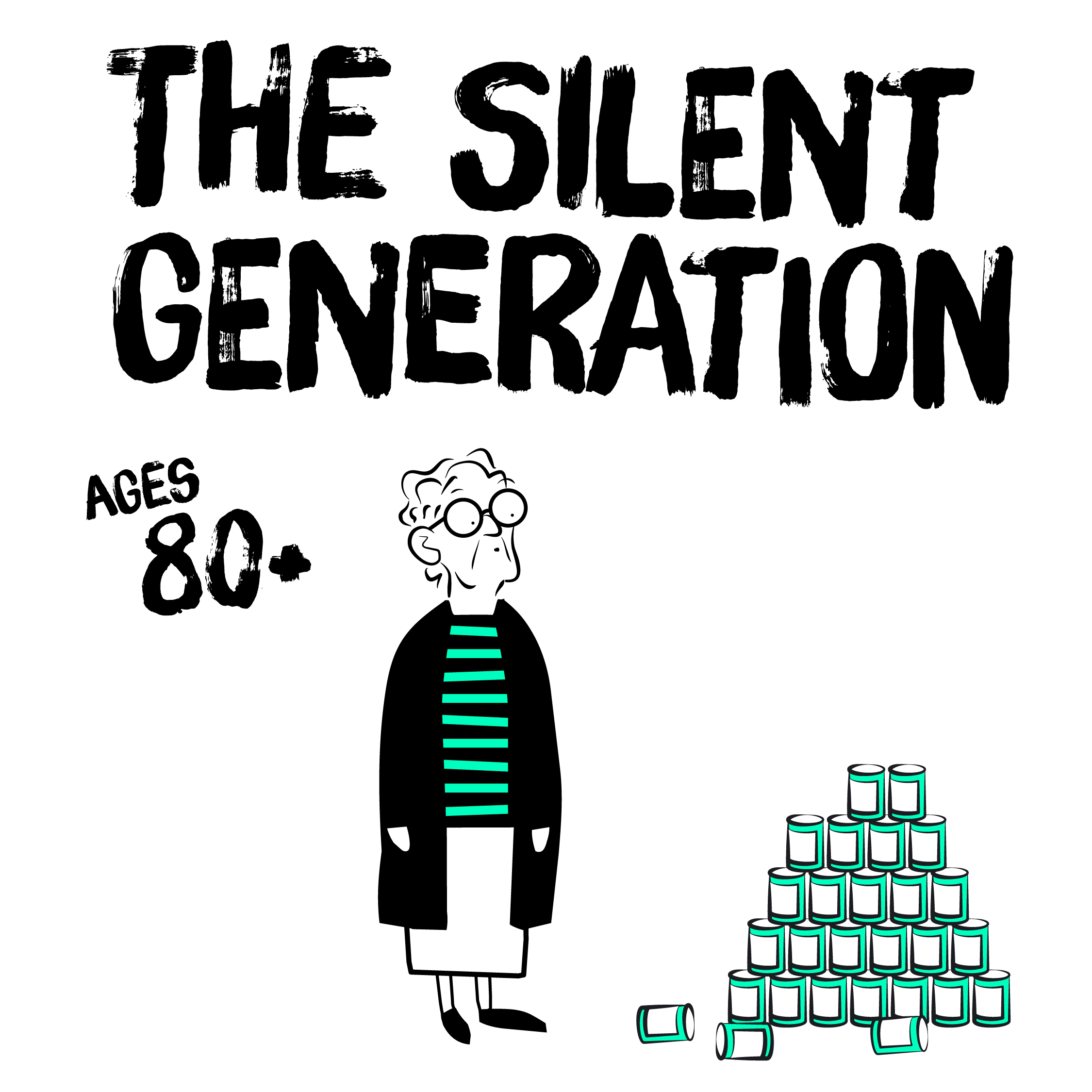
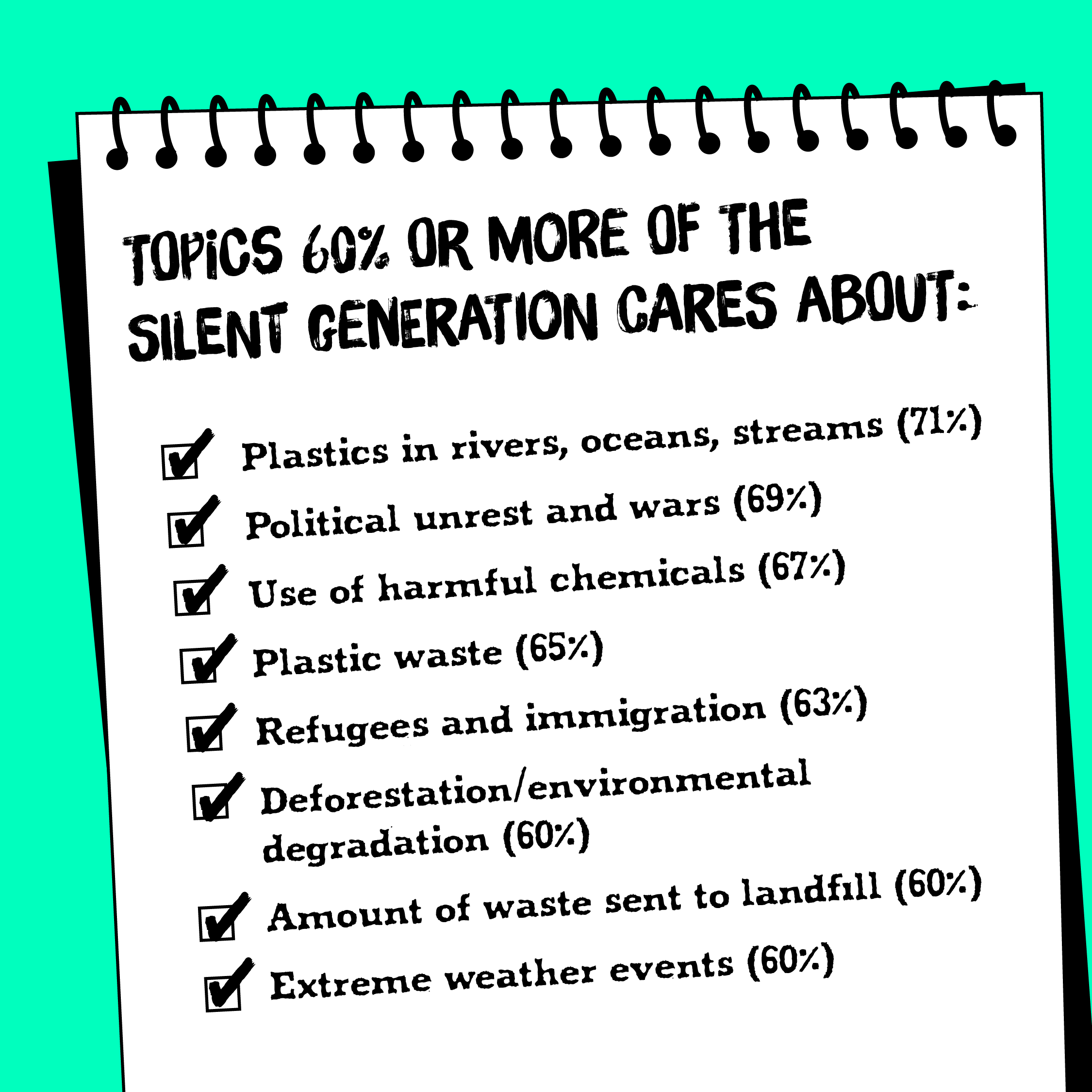
Two of their big topics are plastics and harmful chemicals, and they show strong concern for a wide variety of topics, with eight topics earning over 60% of the Silent Generation’s attention (the most of any generation). In fact, 71% of the Silent Generation cares about plastics in oceans/streams. But those concerns aren’t translating to purchasing decisions: they are the least likely to be persuaded by sustainability promises at checkout.
What they think companies should do: When we asked our respondents to select the top three things companies should be doing, a clear winner emerged for the Silent Generation: 60% believe companies should remove chemicals of concern, the highest response among the options, with no other generations aligning so heavily on a single action. Second, but noticeably lower, was “create no chemical waste in their manufacturing processes,” selected by 27% of the Silent Generation.
Get in their cart: Plastics matter to this group, big time. 71% of the Silent Generation care about plastics in oceans/streams — the highest score of any generation on any topic. But they are the least likely to pay more for sustainable products or be swayed by a company’s environmental reputation in the checkout line. And since this group is more likely to prioritize comfort over the environment and is strongly aligned on chemicals, the best angle to get in their cart is personal health and safety.
Boomers: ages 61 - 79 | "What's that mean for me?"
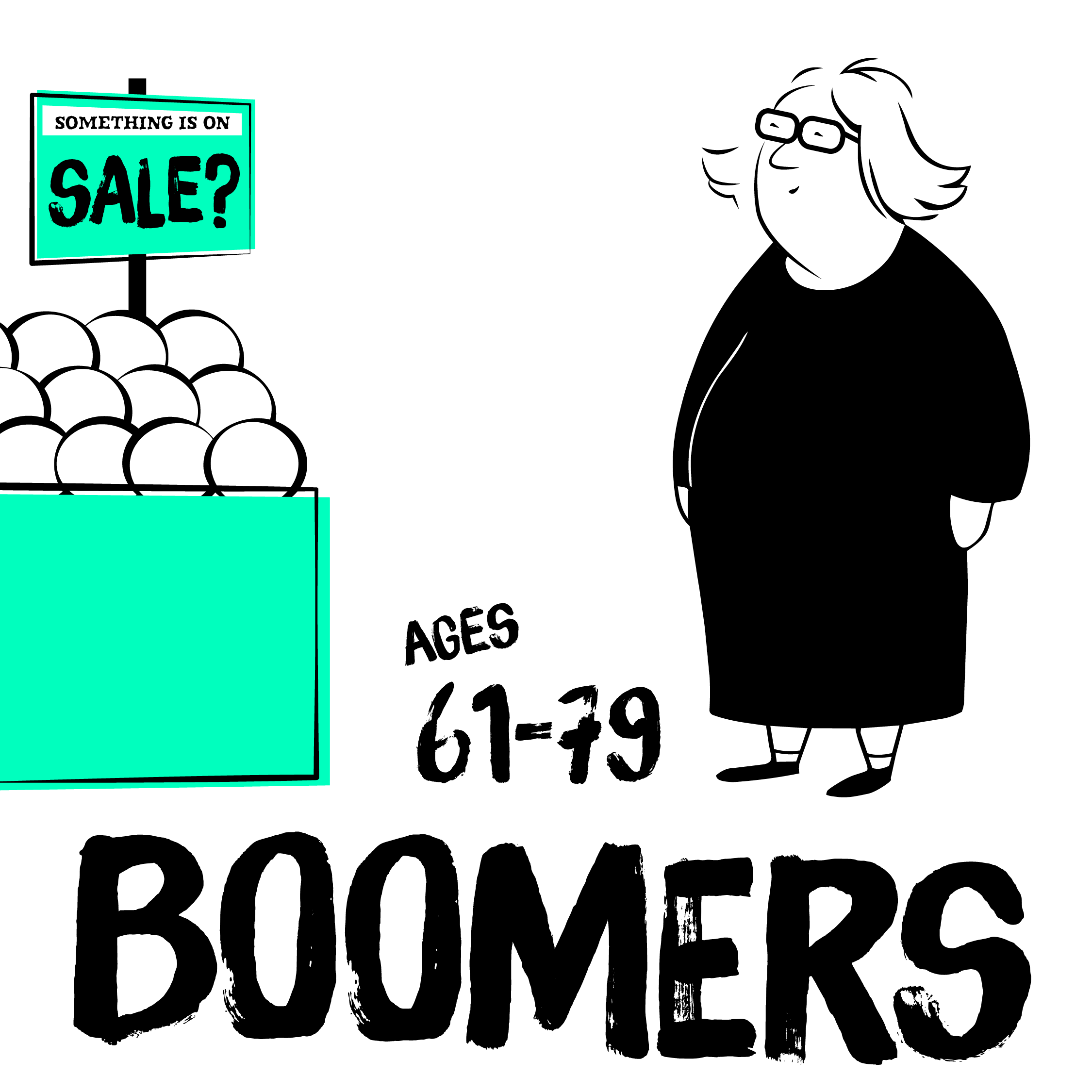
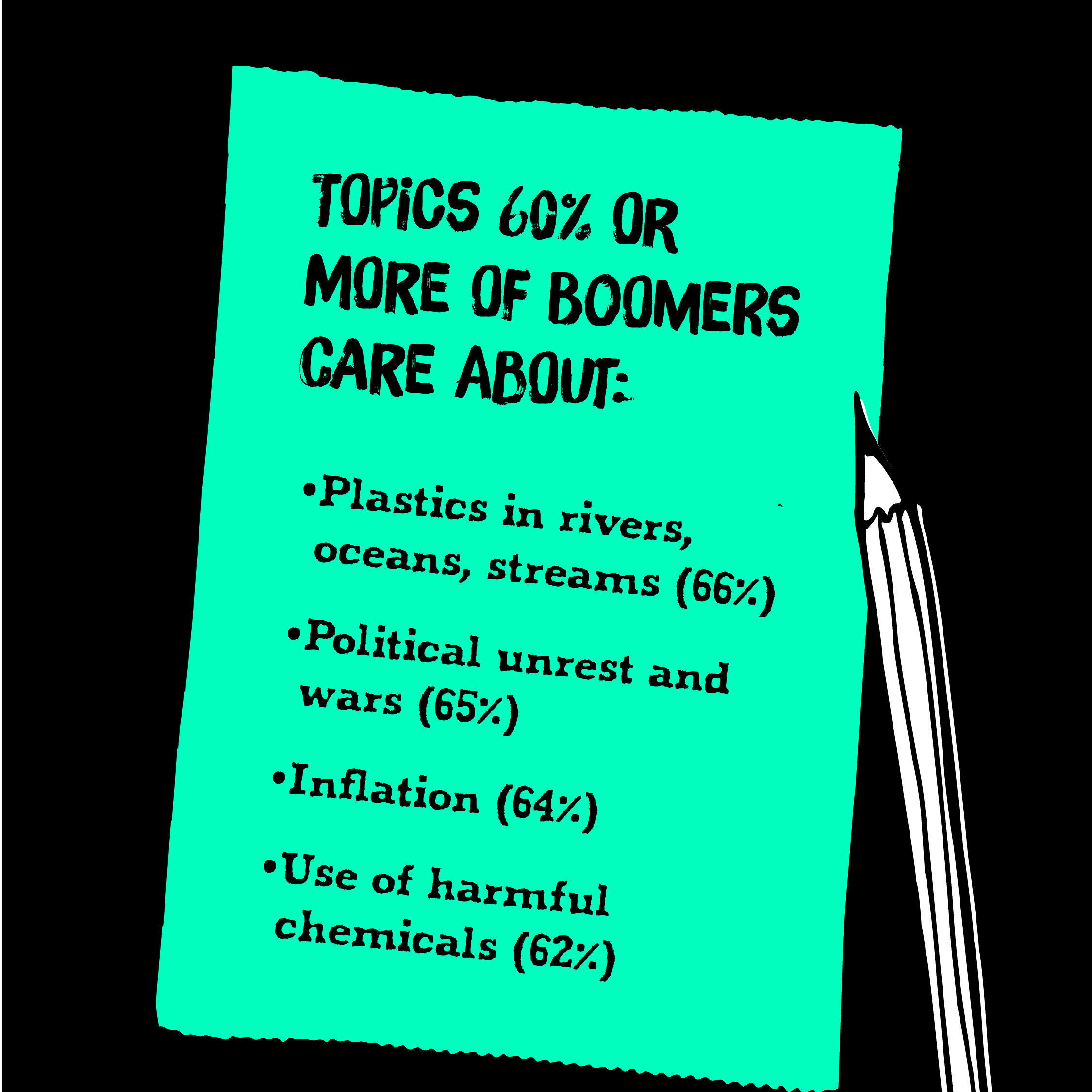
Boomers are also concerned about harmful chemicals and plastics, but slightly less than the Silent Generation. However, they report being more influenced by a company’s environmental reputation than the Silent Generation.
What they think companies should do: Boomers think companies should be responsible for reducing chemicals of concern in products (27%). They want them to treat employees well (22%), yet don’t seem to be associating that with “human rights”, since it is much lower, at only 10%. Companies should manufacture in the U.S. (20%) and buy local products (16%). Also tied at 16% are making recyclable products and supporting the recycling of products they manufacture.
Get in their cart: This generation is all about chemicals and plastic and seems to have a more localized lens. Messaging around ‘in me, on me, around me’ may work, when it comes to chemicals and the local economy and employment. They are likely to pay attention to companies that show a solid commitment to plastic reduction and recyclability, too, but you need to match on price — they demonstrate a below-average willingness to pay more.
Gen X: ages 46 - 60 | "I'm cool with it if it doesn't have chemicals."
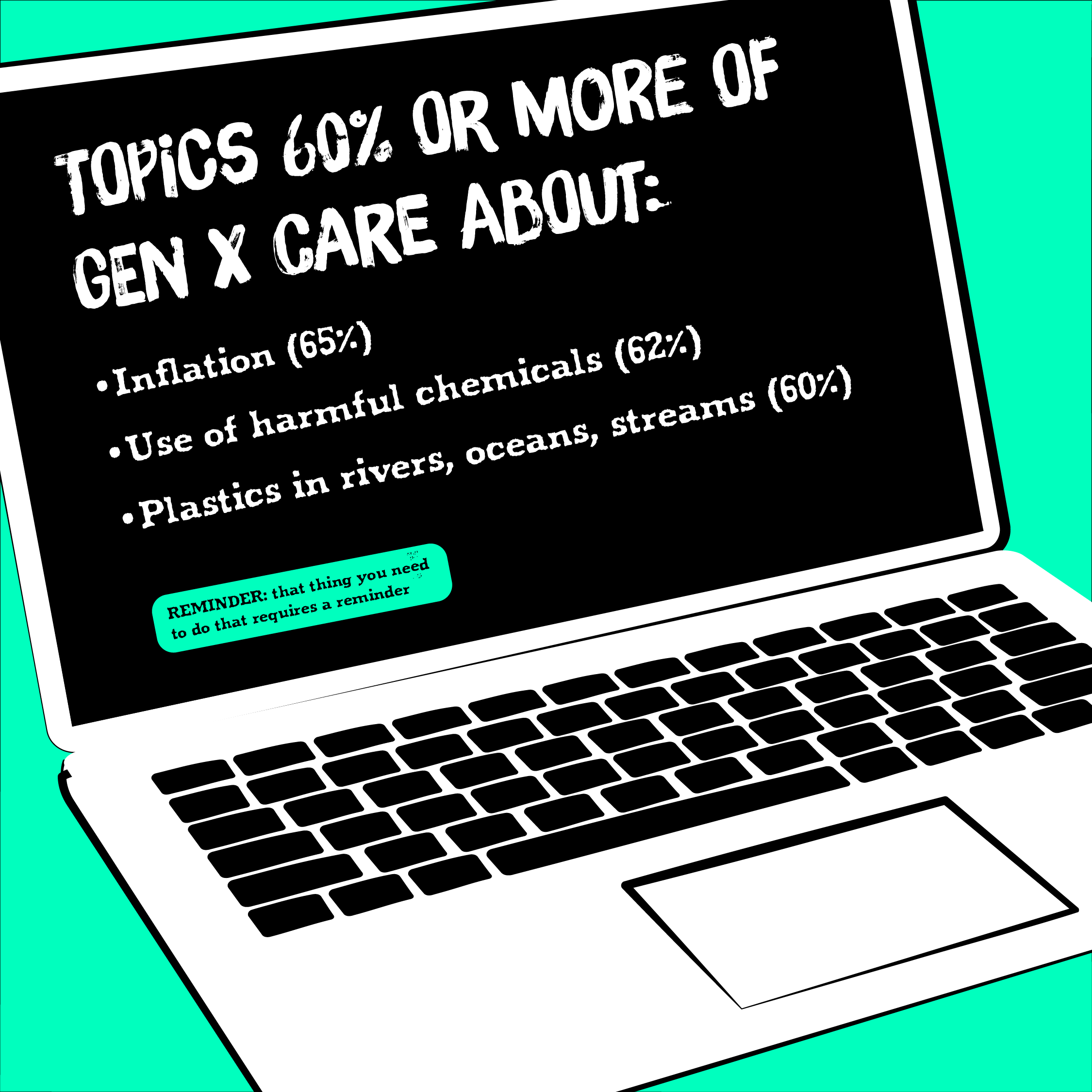
Gen X is currently the largest-spending generation, so you want to get your messaging right for them. But the trouble is, they aren’t asking for anything specific. They are lukewarm on most issues, with only a few standouts.
What companies should do: This is the oldest generation that wants companies to prioritize treating employees well above all else (23%). Chemicals matter too: they want companies to remove chemicals of concern (22%) and create no chemical waste (17%).
Get in their cart: While they are mid-pack on willingness to pay more (38% say yes, and 38% say no), 52% say they’ve never chosen or stopped buying a product because of its environmental or social record. Messaging around chemical safety and plastic waste is the best way to reach this group, but closely matching on price point is still a factor.
Millenials: ages 30 - 45 | "Everything matters. And I want my purchases to show that."
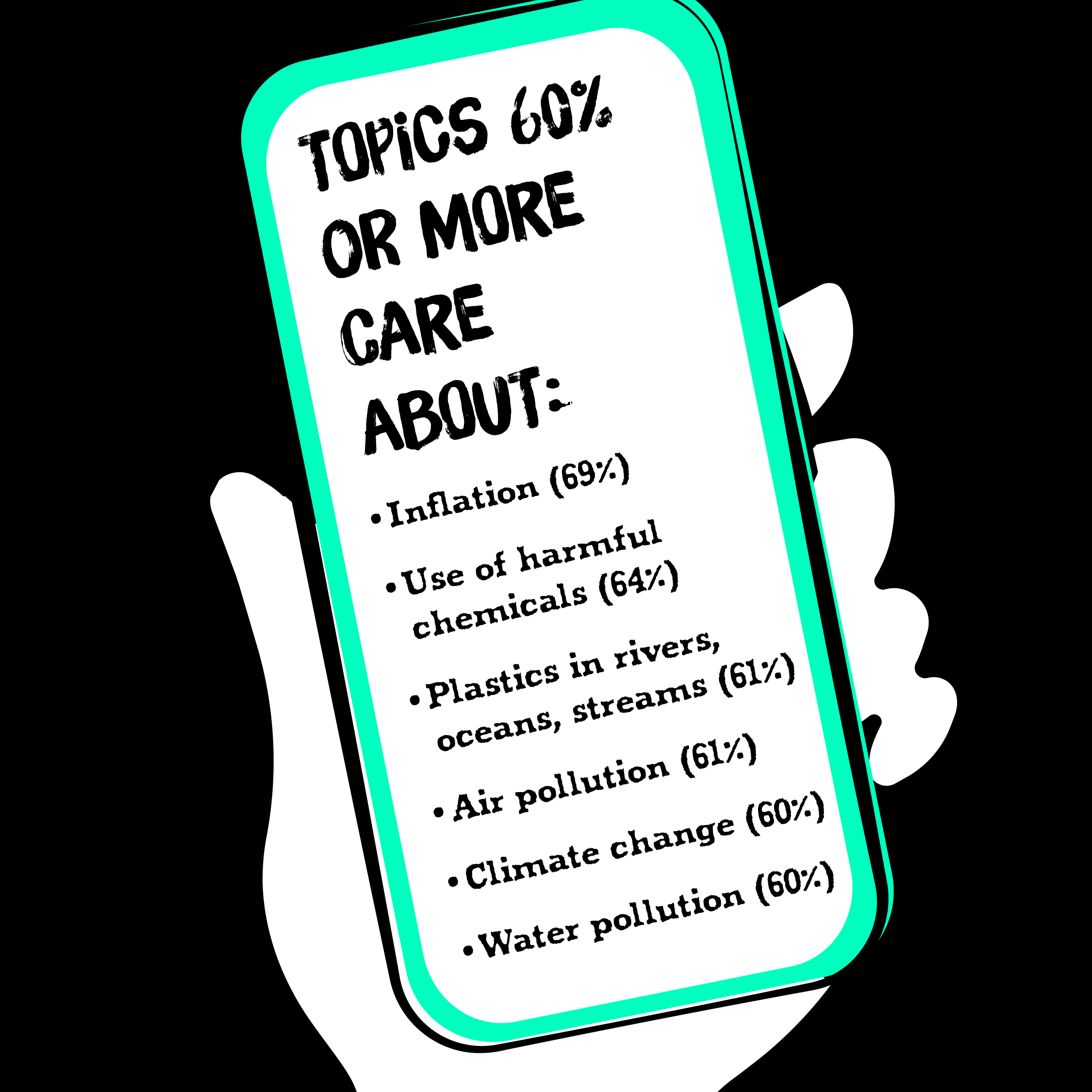
There aren’t a lot of topics that Millennials don’t care about. In fact, remarkably, they still show more concern for the topics they are least concerned about than the mid-range issues for other generations. They tend to lead with environmental and social expectations in purchasing decisions and have the highest belief in man-made climate change at 73%.
Least concerned about: Regenerative agriculture (41%), recycling (45%) and biodiversity (45%). However, while these concern Millennials the least, they are the highest among all generations’ least-concerning topics. This shows that Millennials strongly care about sustainability and social issues.
What companies should do: Millennials want a lot from companies. Their number one is to treat employees well (19%), but they also think companies should remove chemicals of concern in products (19%), protect natural resources (17%), and make recyclable products (16%).
Get in their cart: Most millennials report that they will choose the environment over comfort or convenience. They are the most likely to choose a product based on the environmental record of the manufacturer (42%), but only 30% will stop buying for the same reason. 56% of Millennials are also willing to pay more for social or environmental benefits. This group is likely to respond well to any social and environmental messaging.
Gen Z: ages 18 - 28 (in our study) | "What happens to the planet happens to us.”
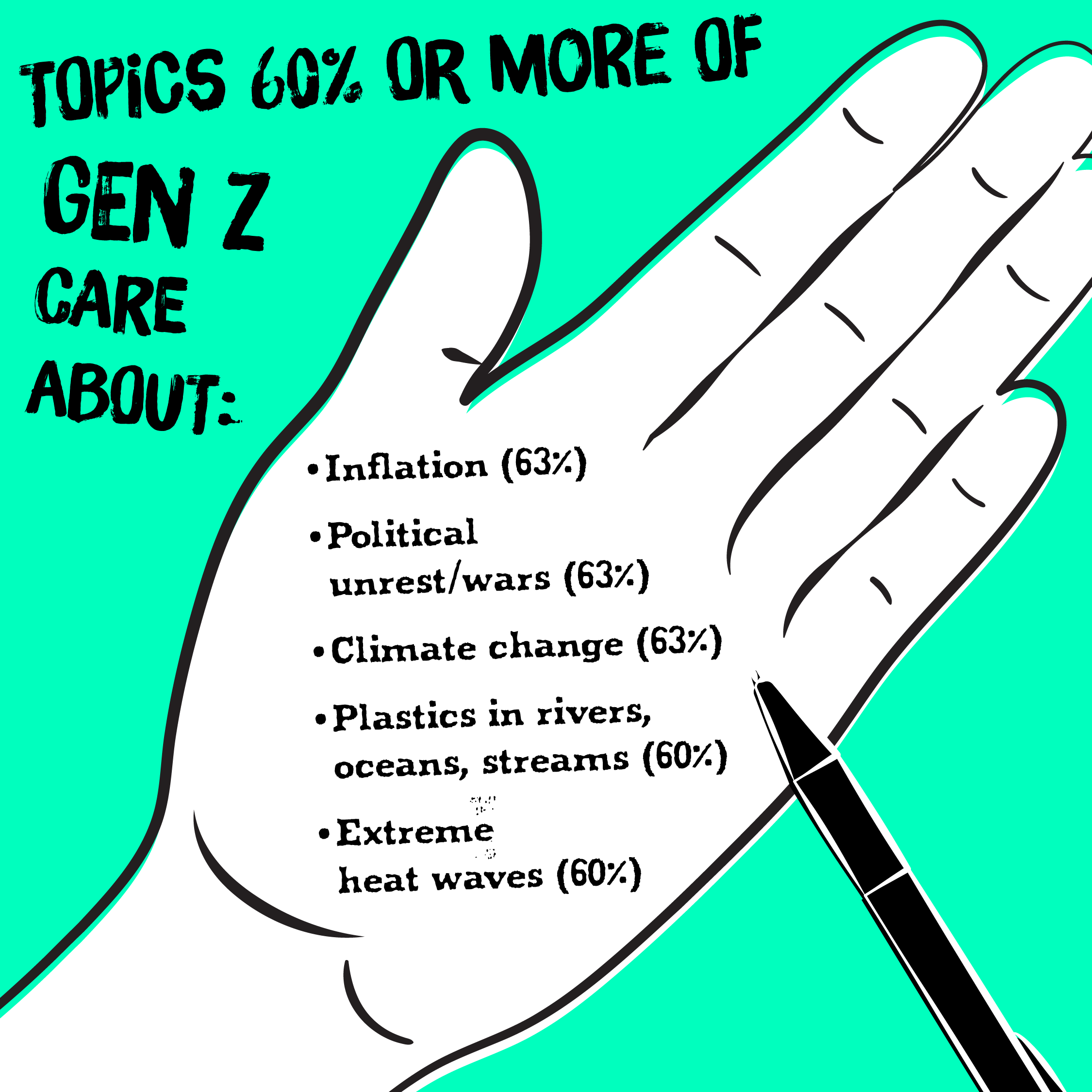
Gen Z follows the Millennials' lead and shows strong interest in social and environmental issues. 72% believe in man-made climate change. Out of all groups, they are the most worried about climate change and heat waves. They take the lead when it comes to concerns about food shortages (at 59%), something that doesn’t stand out as much for other generations. Plastic pollution in waterways shows up again for this generation.
Least concerned about: Shockingly, this generation scores in the mid-to-high 40s for their lowest concerns, showing, much like Millennials, that they care about a lot of things very strongly. The one that stands out? Recycling, at 40%. (This may be because they missed the pre-2000s push for educating on recycling and heard about recycling in a context of failing systems.)
What companies should do: When we asked Gen Z to select three things they believe companies should be doing, the top answer, at 17%, said “treating employees well.” They have the highest share that chose “identify and eliminate human rights violations in their supply chain.” Transparency and chemicals of concern are in the top responses as well.
Get in their cart: They care about the environment, 40% choosing it over both comfort and convenience. They have a high willingness to pay more and are the most likely to stop buying a product based on social or environmental reputation. They recognize that global issues impact them at home and may see environmental issues through a people lens — they care about human rights, climate change and heat waves, and other social issues, like inflation and political unrest. People-centered messaging is the way to get into the carts of Gen Z.
So, what's next for our milk-buying excursion?
Okay, we’ve established that consumers still care about sustainability; they hold themselves accountable for it, want businesses to do more, but trust companies less.
And decoding sustainability messaging can be overwhelming. But 78% of consumers still say they want to hear from companies about their environmental efforts.
Lastly, in Chapter 3, we walked down the aisles with our Milk Buyers. We learned that plastics and chemicals are hot topics, Millennials care about everything, recycling doesn’t stand out as much as we might expect, and the importance of biodiversity and soil are underestimated.
So now, it’s time to put our findings to good use. Most brands are treating sustainability like a singular message, but the brands that treat it like an entire system will win in the marketplace.
Want to know how you can do that? Download our blueprint below.